As Public Policy Lab marks its 15th year, we’re publishing a series of essays reflecting on the projects that shaped us and what they’ve taught us about public-interest innovation. Each post is paired with a related conversation, bringing practitioners together to explore the theme and its implications for the future of public systems. This essay is part of the PPL15 series.
Last summer, I attended the Creative Bureaucracy Festival in Berlin, and someone asked me, Is the Public Policy Lab the longest-running government innovation lab in the world? I pointed to our respected colleagues at TACSI or at La 27e Région as the likelier holder of that title, but the question suggested new problems to consider: If innovation is the process of using information from the world as it is to invent something new and useful for a world we prefer, what has PPL learned about how to dream of transformation, even as we’ve been progressively weathered by bureaucratic timescales, political friction, funding shortfalls, and our own errors of judgment and execution? What has 15 years of practice taught us about skills and approaches to innovation, sure, but also how to conceive of innovation itself? (Yes, my nerds, the ontology, in addition to the epistemology.)
That’s the oblique topic of this post, as well as eleven more that we’ll post across 2026, our 15th anniversary year. My colleagues will share behind-the-scenes details of some of PPL’s most interesting projects, but more importantly, they’ll consider what those projects mean—what they suggest about the use of creative invention to support our democratic project.
Where we are now was not obvious from where we started. In the summer of 2008, I had lunch with Sylvia Harris. We’d remained in touch since working together on a project at the Design Trust for Public Space, and now Sylvia had an urgent insight: “Barack Obama is going to win this election,” she said, “and the design community is not getting ready.”
As the creative director for the 2000 Census for the U.S. Census Bureau, Sylvia had seen how thoughtful design could support crucial American public services—and she’d observed how different administrations had varying levels of awareness (or interest) around using design for the public good. “George Bush took office, and the phone stopped ringing!” she laughed.
Over the following months, Sylvia and her friend and former business partner, David Gibson, organized a recurring meeting with a number of New York City designers under the mantle of Design for Democracy, a long-running initiative of the AIGA, the professional organization for design. We began exploring ways to demonstrate the value of strategic design to the incoming administration. In May 2009, as fallout from the financial crisis continued, we created a speculative redesign of the so-called “Schumer box” for credit-card disclosures; published in the New York Times as an op-ed, it made the case for better communications design as a form of consumer protection.
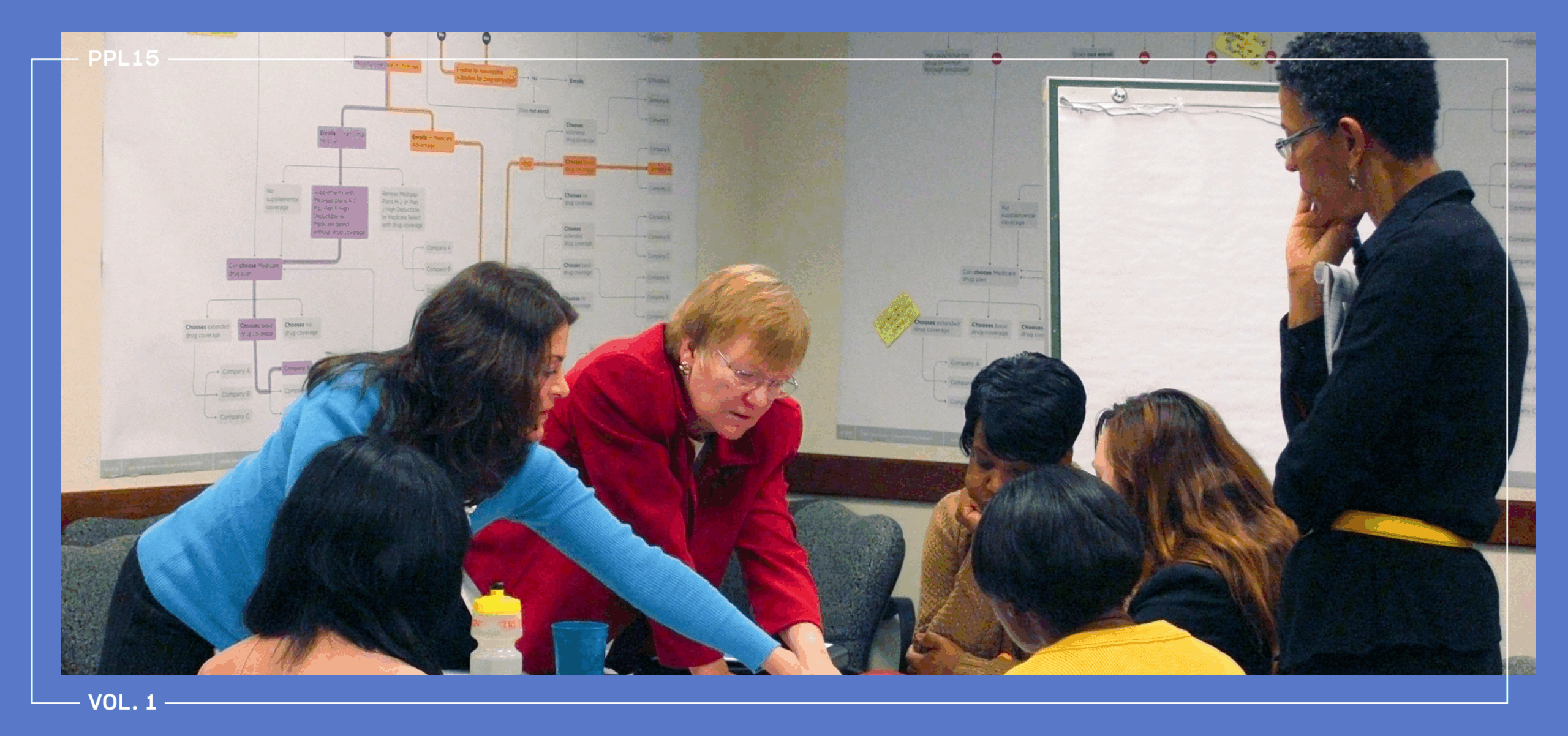
Shortly after publication, an administrator at the Centers for Medicare & Medicaid Services (CMS) reached out to see if we had thoughts on how the agency could make it easier for beneficiaries to choose a Medicare plan. We provided what may have been the first human-centered design guidance that CMS had received and subsequently joined an effort to redesign the Medicare Summary Notice (MSN), the quarterly explanation of benefits sent to 35 million–plus original Medicare beneficiaries. Our dream of doing public interest design was now occurring at scale, even though we were still operating as an ad-hoc band of do-gooders.
By mid-2010, as I worked with Sylvia and her team, as well as with David and his staff at Two Twelve on redesigning the MSN, several things became evident:
To launch a new organization with no funding in a highly regulated market with no demand for our services—readers, in retrospect, it seems foolhardy. What made us think we could do this? It helped that I personally was somewhat desperate: I’d reached the limits of my then-role running a community-based organization, I wanted a job that flexibly accommodated my responsibilities as a parent of young children, and I wanted to do ambitious service-design work that capitalized on my interests in policy and system design. No one was offering me this dream job. It wasn’t clear that the job I wanted even existed in the United States.
Crucially, I’d run a nonprofit previously, and I was the child and spouse of small-business owners. No one close to me believed I had to take a job if I could make one. Meanwhile, Sylvia and David were themselves entrepreneurs; they had co-founded Two Twelve after graduating from Yale’s design program in the mid-1970s, and Sylvia later launched her own practice. Both of them knew it was possible to build an organization from scratch.
We also saw a major opportunity: The Medicare project showed us that although there was no widespread uptake of human-centered service design in government, government partners were ready to adopt new approaches. The challenges we saw were systemic, not cosmetic, and addressing them would require building something durable enough to work across agencies and political cycles. The landscape was ripe for innovative intervention. In January 2011, I left my job, updated my LinkedIn, and filed incorporation papers with the state of New York.
This conviction, that the creation of something new is not just desirable, but entirely plausible (and even manageable), is a keystone of the Public Policy Lab’s successful innovation process. Over time, we’ve proved that transformative solutions don’t spring from optimism alone. They emerge through dedicated practice: by paying close attention to where systems fail people, by testing small ideas before scaling them, by learning from missteps, and by surrounding ourselves with partners who are willing to imagine something better and stay with the work long enough to build it. After 15 years as executive director of Public Policy Lab, I’ve come to see innovation as a continuously improvable craft, the product of a regular practice that requires us to repeatedly rekindle a spark of delight and strangeness, even when conditions make that feel unrealistic.
To do this work in the public interest, with and for our neighbors and fellow citizens, we have to make our dreams shareable. We have to invite others into the belief that public systems can be designed differently and better. Public-interest innovation is, at its core, a collective capacity to dream and build a more humane social compact. In the posts that follow this one throughout our anniversary year, my colleagues and I will return to that idea, reflecting on the projects that shaped us and the lessons they offer for anyone still willing to dream—and to practice making those dreams real.
PPL is a tax-exempt 501(c)(3)
nonprofit organization.
info@publicpolicylab.org
+1 646 535 6535
20 Jay Street, Suite 203
Brooklyn, NY 11201
We'd love to hear more. Send us a note and we'll be in touch.
We're currently seeking applications for a Graduate Summer Intern. If interested, learn more about the role here.
To hear about future job announcements, follow us on Instagram, Twitter, Threads, and LinkedIn or subscribe to our newsletter.
Enter your email below to subscribe to our occasional newsletter.
Wondering what you’ve missed?
Check out our
The Public Policy Lab is a tax-exempt
501(c)(3) nonprofit organization.
Donate now to support our work; your
gift is tax-deductible as allowed by law.