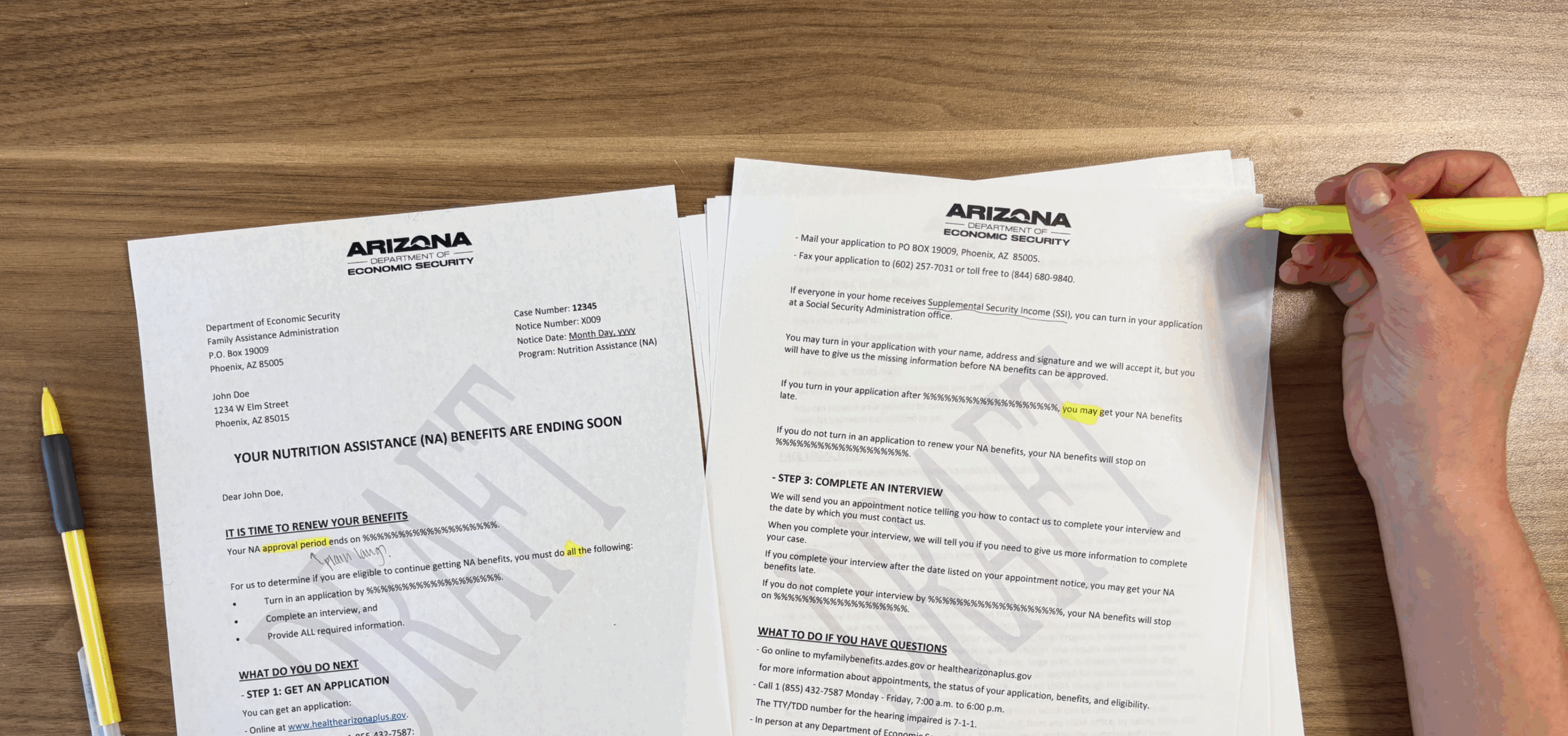
Arizona’s Department of Economic Security (DES) provides a range of public benefits programs for residents and recognizes opportunities to improve the ease and efficiency of its communication with applicants and participants. PPL partnered with the state to modernize key materials—improving clarity, tone, and usability.
PPL rewrote and redesigned the notices associated with state programs for food assistance and childcare, with the goal of increasing administrative efficiency while reducing the time from application to benefit receipt or renewal. Clearer communications reduce errors, streamline interactions, minimize client frustration, and make better use of public resources.
Arizona’s Department of Economic Security (DES) provides a range of public benefits programs for residents and recognizes opportunities to improve the ease and efficiency of its communication with applicants and participants. PPL partnered with the state to modernize key materials—improving clarity, tone, and usability.
PPL rewrote and redesigned the notices associated with state programs for food assistance and childcare, with the goal of increasing administrative efficiency while reducing the time from application to benefit receipt or renewal. Clearer communications reduce errors, streamline interactions, minimize client frustration, and make better use of public resources.
The state of Arizona is working on a multipronged effort to enhance the client experience and operational efficiency of the state’s public benefits programs, including the launch of a new integrated benefits online platform, A to Z Arizona. The platform will streamline clients’ application to and management of programs including Supplemental Nutrition Assistance Program (SNAP), Temporary Assistance for Needy Families (TANF), Child Care Assistance, and others. As one element of this initiative, DES is focusing on the modernization of program notices—such as application confirmations, eligibility determinations, and renewal notices—sent to members of the public in multiple languages.
The Public Policy Lab is partnering with DES to lead the modernization of these notices over the course of eighteen months, with redesigned notices rolling out in stages and beginning to be implemented at scale by the end of 2026. Clear, streamlined communications between clients and agency staff will mean less time spent clarifying requests and correcting errors, increased client satisfaction and response rates, and a more efficient use of the public resources that support these programs.
Notices Reviewed
Research Participants
We conducted research focusing on the following inquiry areas:
Our research began with reviewing policy resources from federal and state sources, contextual resources on Arizona demographics and DES benefits programs, and past work in this area.
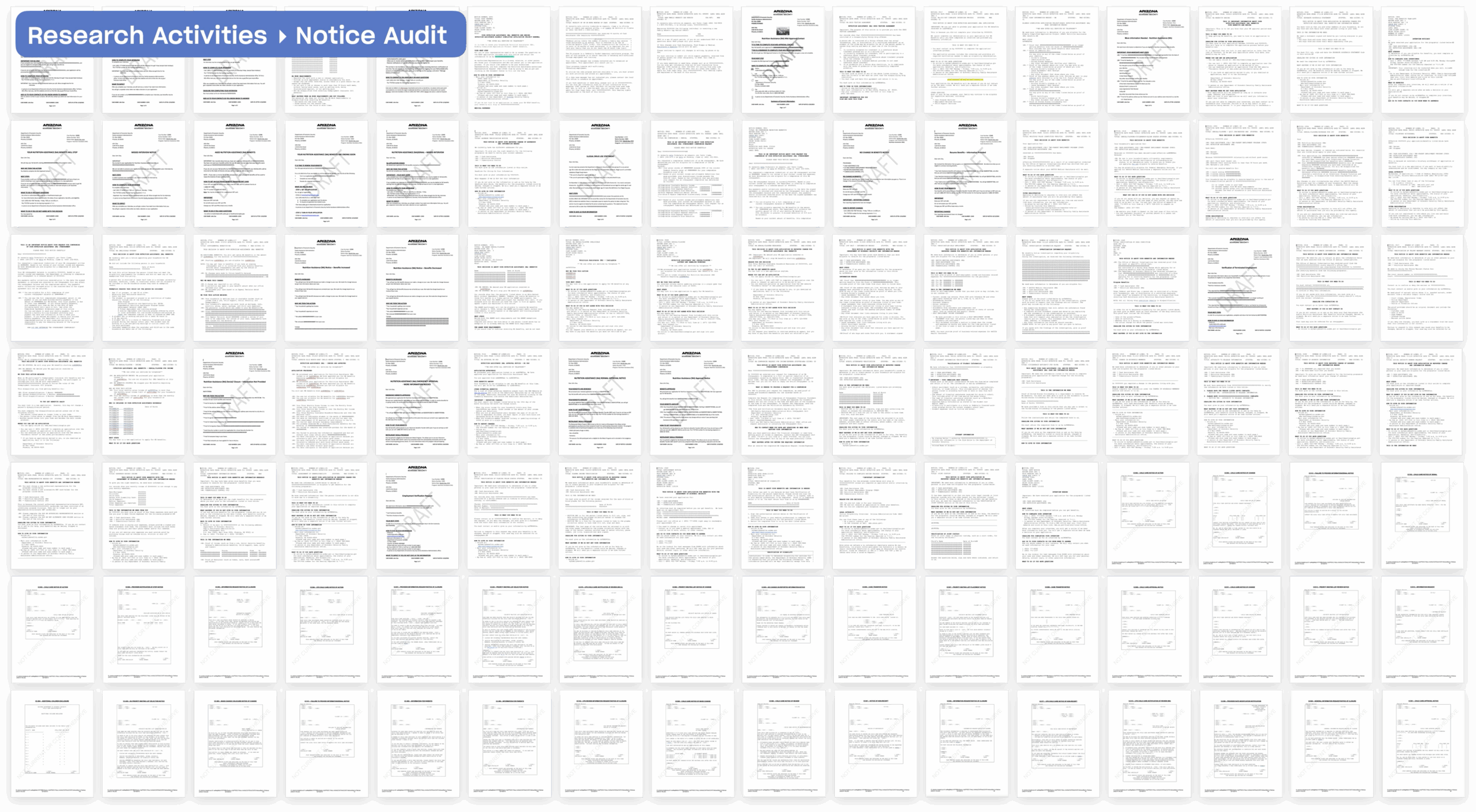
We then assessed over 150 notices across the SNAP and Child Care Assistance programs. After reading, cataloguing, and summarizing each notice, we tagged them across a variety of form elements—like the journey phase in which the notice is distributed, what triggers the notice, and what category of information the notice falls under.
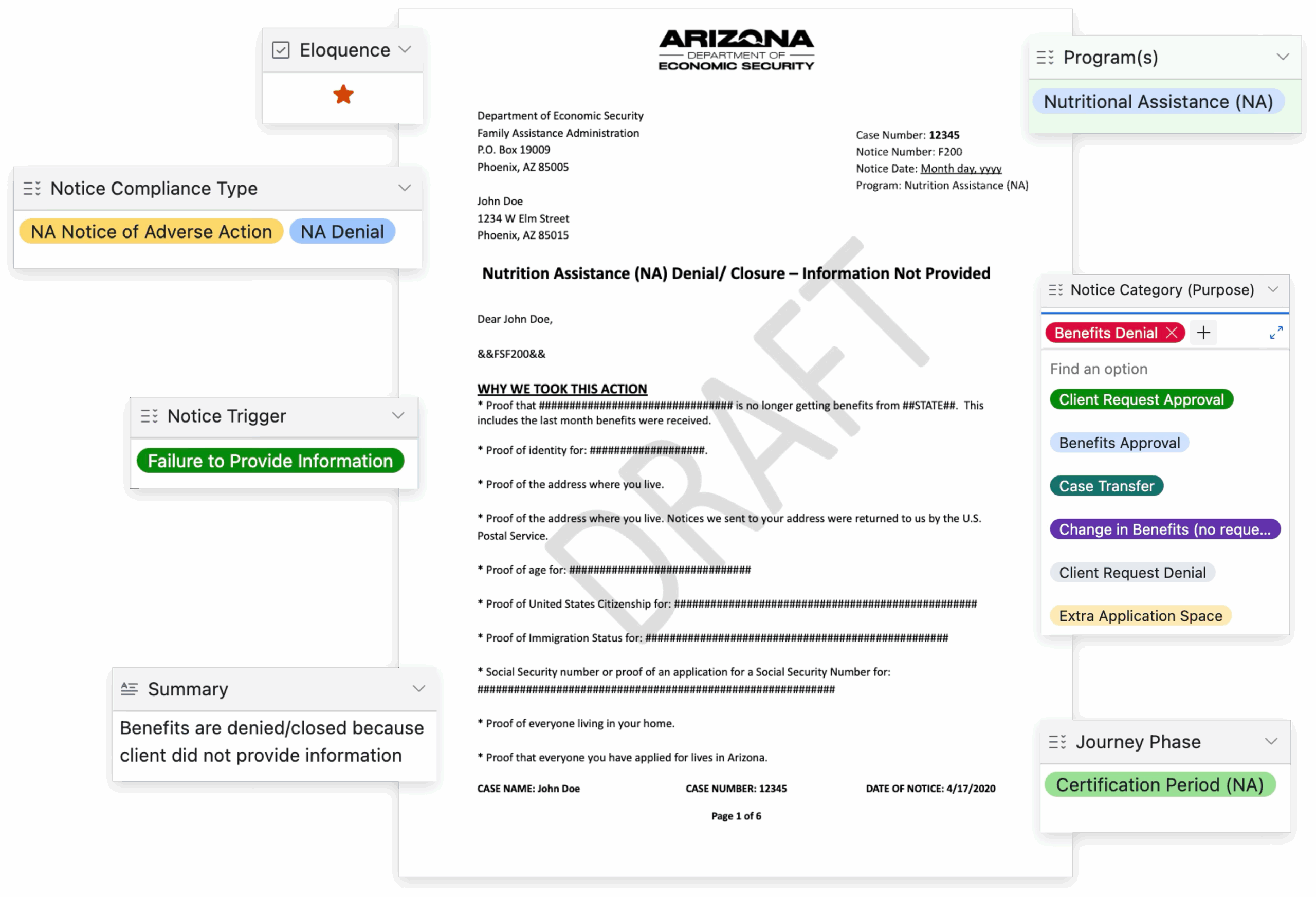
Notices Review
We assessed over 150+ notices across SNAP and Child Care Assistance programs.
Through workshops and small group interviews, we also conducted human-centered research with eighteen participants, including Arizona DES frontline staff, community-based organization (CBO) staff, subject matter experts, and members of the public who receive benefits.
We learned that the notices are produced using back-end systems that vary across programs and have different capabilities and limitations when it comes to notice design. Some benefit programs are able to use formatting tools to create notices with bolded headers, icons, and easy-to-read fonts, while other programs must distribute notices directly from mainframe systems that don’t allow much formatting. This means that clients who apply for or are enrolled in multiple programs may receive notices that look different from one another, which can be confusing.
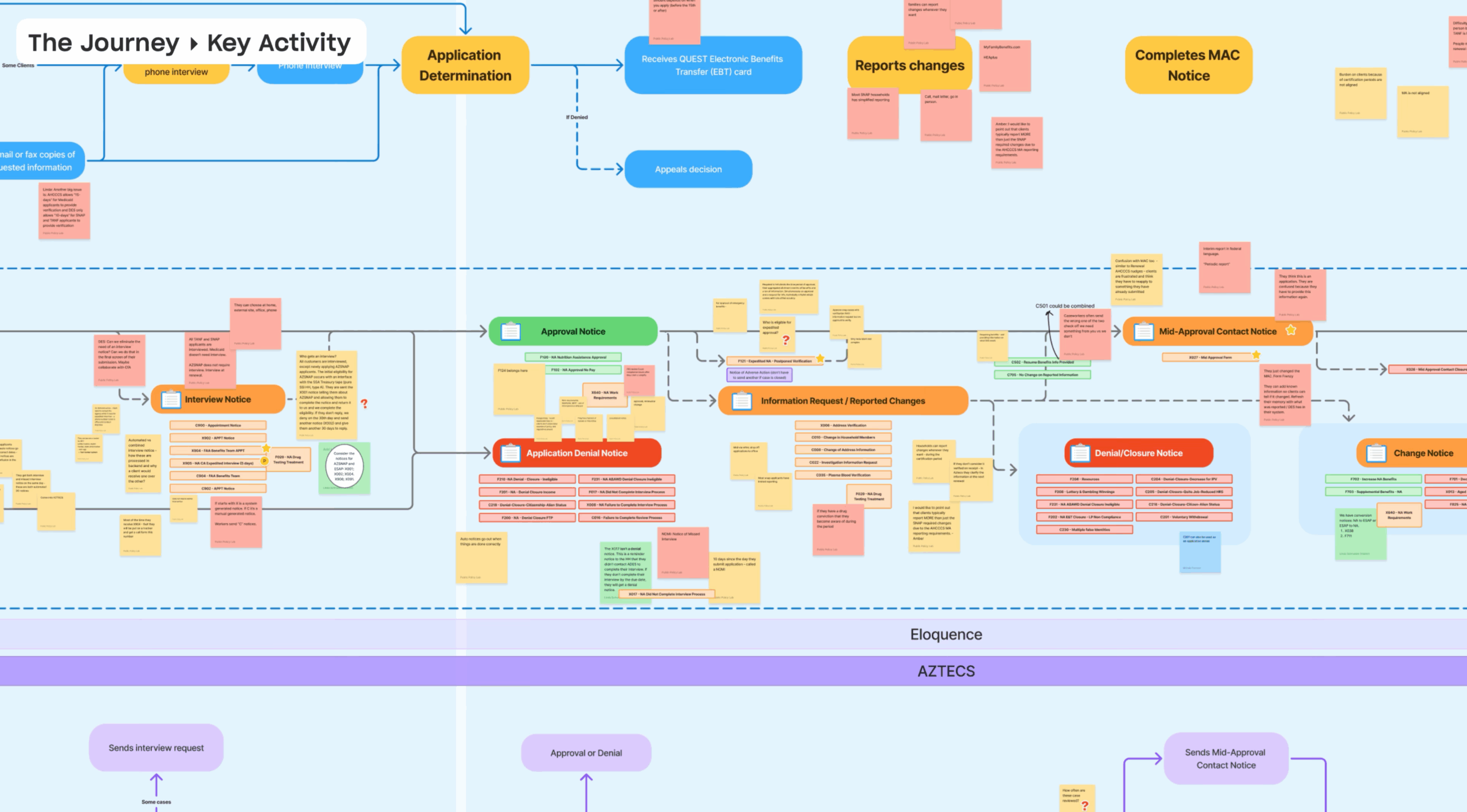
Policy and System Expert Workshop
In a workshop with policy and systems experts, we visualized the Arizona notices journey from awareness to renewal.
We also found that the policies that govern SNAP and childcare notices are clear on what needs to be included in different types of notices, but don’t give detailed guidance regarding appearance or exactly what needs to be said.
To better understand the journey of DES staff and clients, we conducted workshops with policy and systems experts. Together, we visualized the journey for both clients and staff as they navigate the five stages to access and maintain Arizona’s SNAP and Child Care benefits: awareness, pre-application, application, certification period, and renewal. We mapped where notices appear along this journey and indicated when conversations occur between clients and staff.
In exploring client preferences, we heard three principles repeatedly:
Based on what we learned through research, we created low-fidelity prototypes of redesigned notices. We iterated on these prototype designs with clients, staff at community-based organizations, and experts in program operations and policy compliance.
Through codesign workshops, we tested versions of notices that differed in tone, wording, information architecture, and layout. Participants marked up the notices, indicating areas that felt confusing or wording that spurred feelings of trust. We observed where clients got stuck and what design and language elements proved cumbersome.
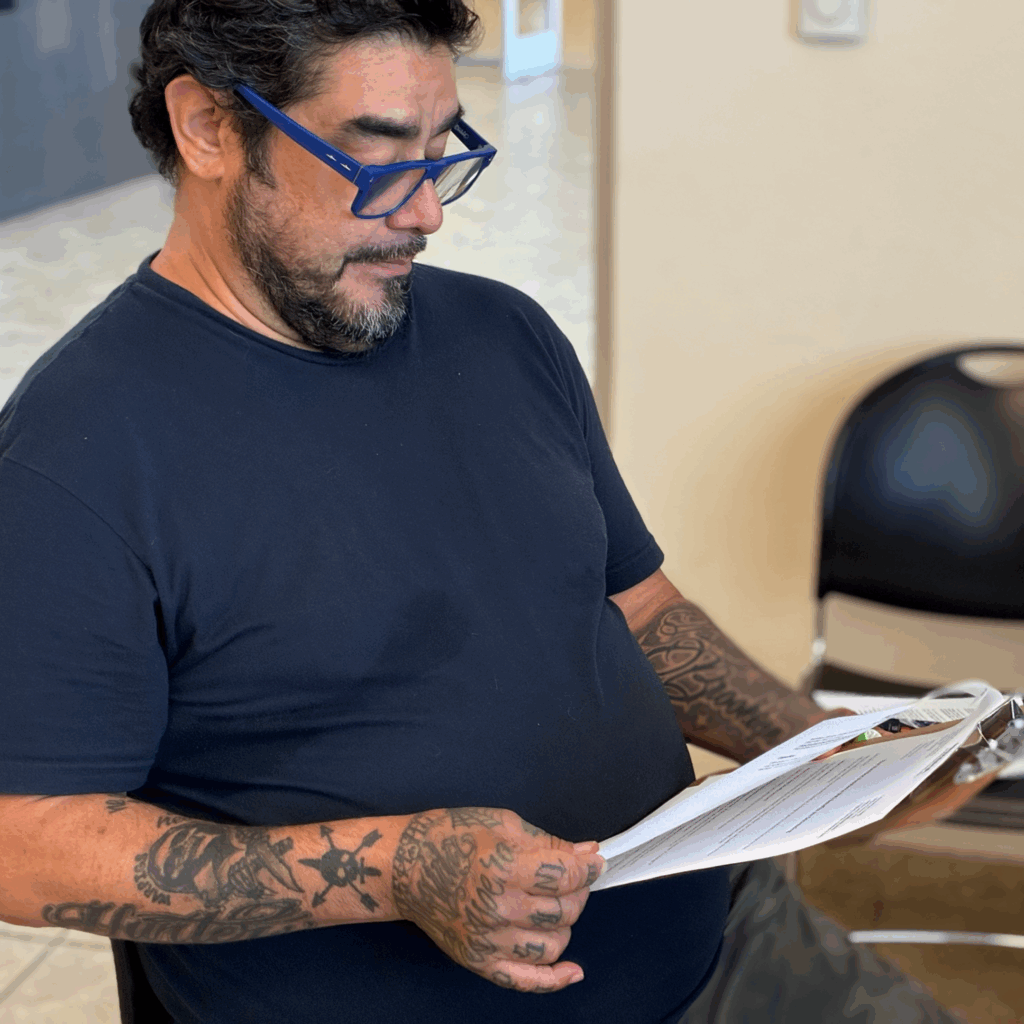
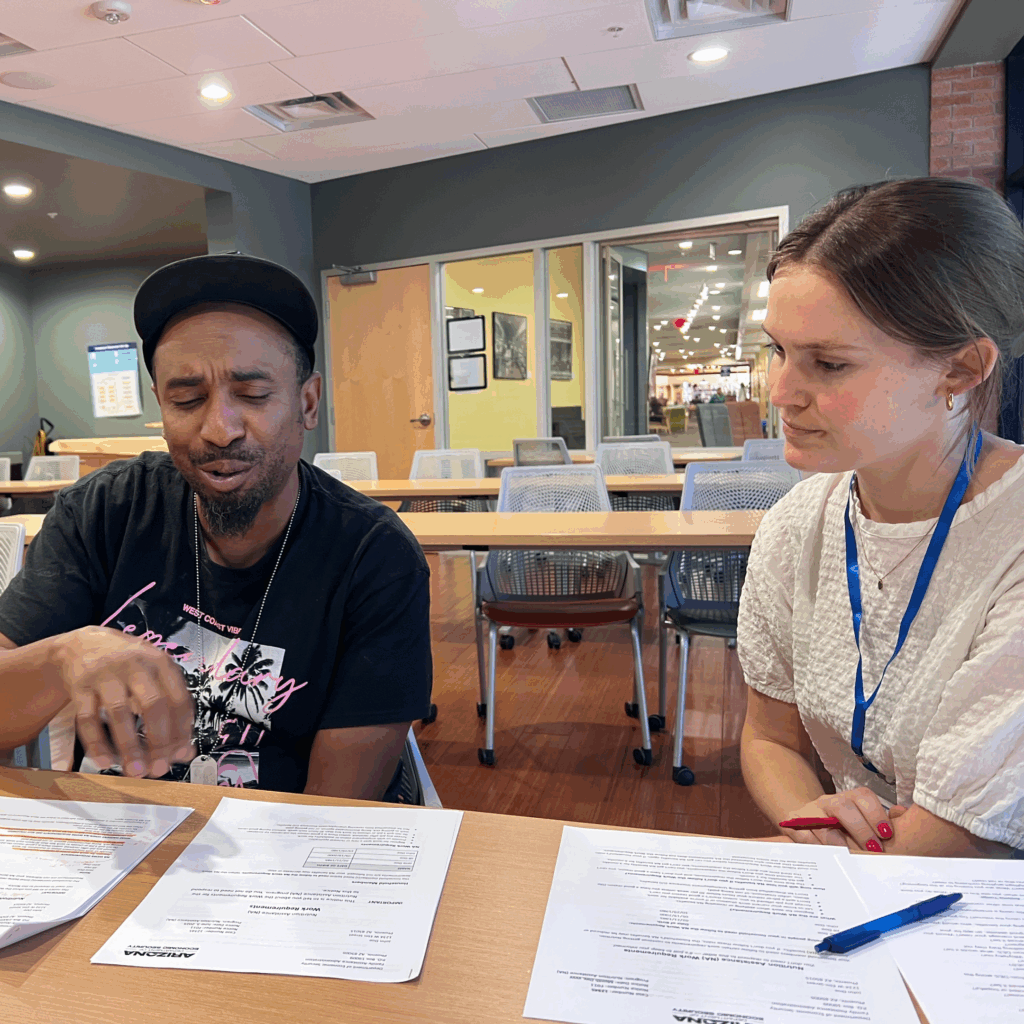
Some clients preferred notices with a warm tone, while others preferred notices that were to the point. Clients generally preferred short and concise sentences, but sometimes adding a few more words for clarity helped their understanding.
Overwhelmingly, clients wanted to feel like the notice was personal. They wanted to see specific reasons why information was being sent to them or see their case details reflected. Titles like “We Need More Information From You” were often better received compared to “More Information Needed”.
We used our findings to redesign a set of ten SNAP notices and six Child Care Assistance notices, which served as our test notices. To give us a diverse set of samples to test, we chose notices that prompted client action and that represented different formats or layouts (e.g., short vs. longer informational sections and information requests).
In reimagining the notices’ visual design, structure, and written content, we implemented elements such as:
Beyond the notices themselves, we explored updates to supporting communication materials, including the creation of a client journey map to send after application submission. We also redesigned existing enclosures that are sent out with notices, like change report forms, hearing requests, and informational one-pagers.
Pilot Testing
In late 2025, we tested redesigned notice and enclosure prototypes with Arizona clients. We combined in-depth qualitative research with comparative A/B testing, engaged both English- and Spanish-speaking participants, and focused on testing the highest-impact, most complex notices.
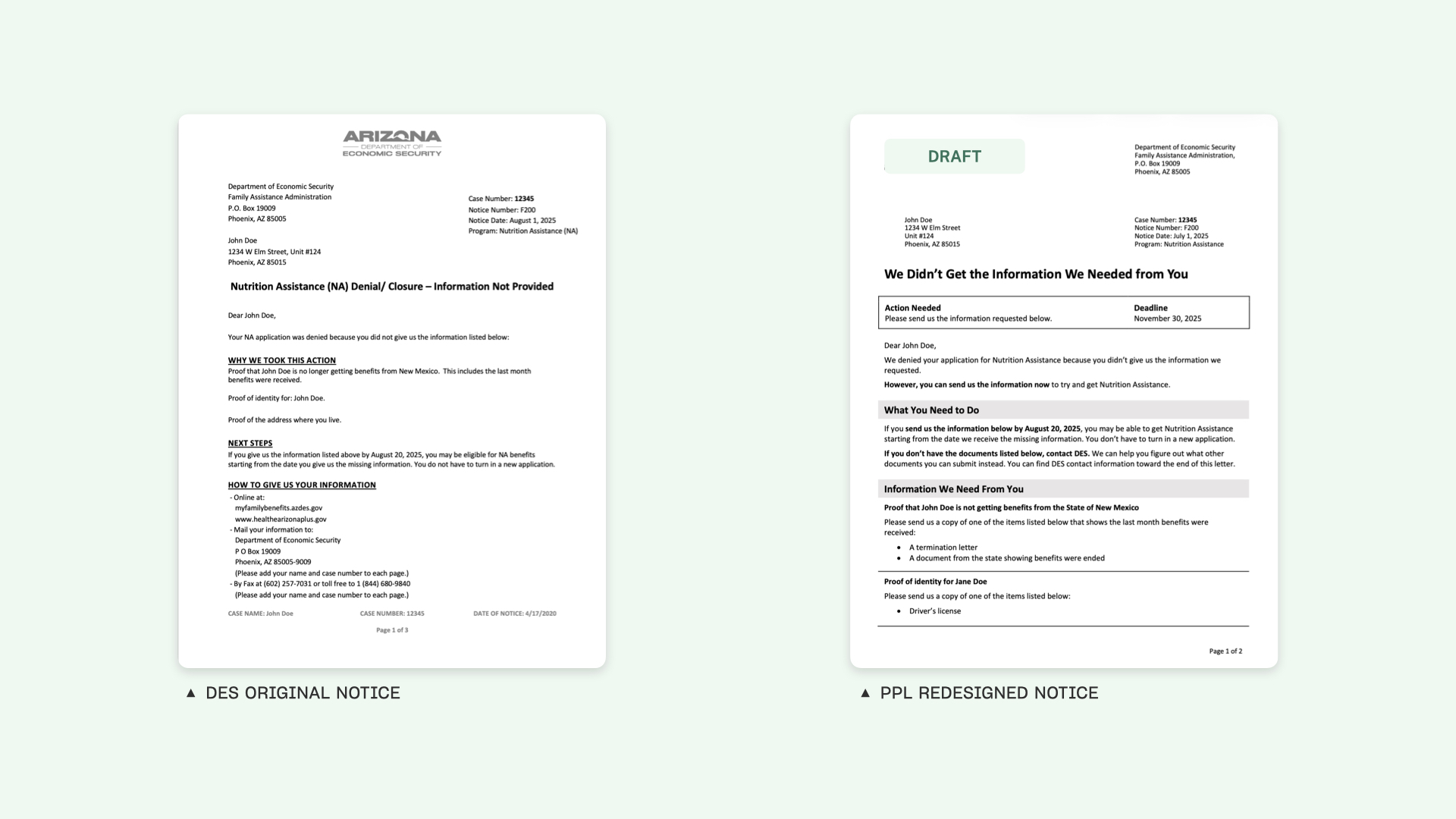
Participants showed a clear preference for PPL’s redesigned notices: 71% of Child Care Assistance pilot participants and 82% of SNAP pilot participants said the redesigned notices were easier to read compared to the originals.
We learned three key insights from pilot testing:
1. First impressions are everything.
2. Specificity promotes client action.
3. Tone matters for client connection and agency.
Additionally, given the nationwide focus on reducing states’ SNAP payment error rates, we focused in particular on SNAP notices that may drive client-driven errors: notices that request information from the client or ask them to report changes. When testing these notices and forms, we identified moments where language choices could directly impact clients’ ability to report income accurately:
[The PPL version] doesn’t sound so authoritative. It sounds like you actually care about what’s going on, where [the DES version] sounds like you’re just another number in the system.”
—Participant in A/B testing
Redesigned Materials
We used our pilot learnings to improve Arizona’s entire system for food and childcare notices. Starting from an inventory of 167 SNAP notices and 48 Child Care Assistance notices, we combined duplicates and retired outdated notices to land on a final set of 127 SNAP and 29 Child Care Assistance notices to redesign. We asked DES partners to carefully review the most complex and highest-impact notices first, then applied that input to the full set.
We also redesigned a set of enclosures—informational materials or forms sent in envelopes alongside notices—to complement the notices. This included forms crucial to error rate reduction for SNAP, such as the Change Report Form, as well as enclosures designed to streamline the information request process for Child Care Assistance.
Interested in learning more? Check out our webinar on best practices for designing benefits notices.
In May 2026, we delivered the full set of redesigned materials to DES, identifying high-priority notices to begin implementing first. We worked with DES to understand each program’s biggest priority for implementation. For Child Care Assistance, we prioritized the most frequently sent notices; for SNAP, we prioritized notices and enclosures thought to be linked to client-driven errors.
We also provided resources to support DES in implementing the materials and scaling to other programs, including:
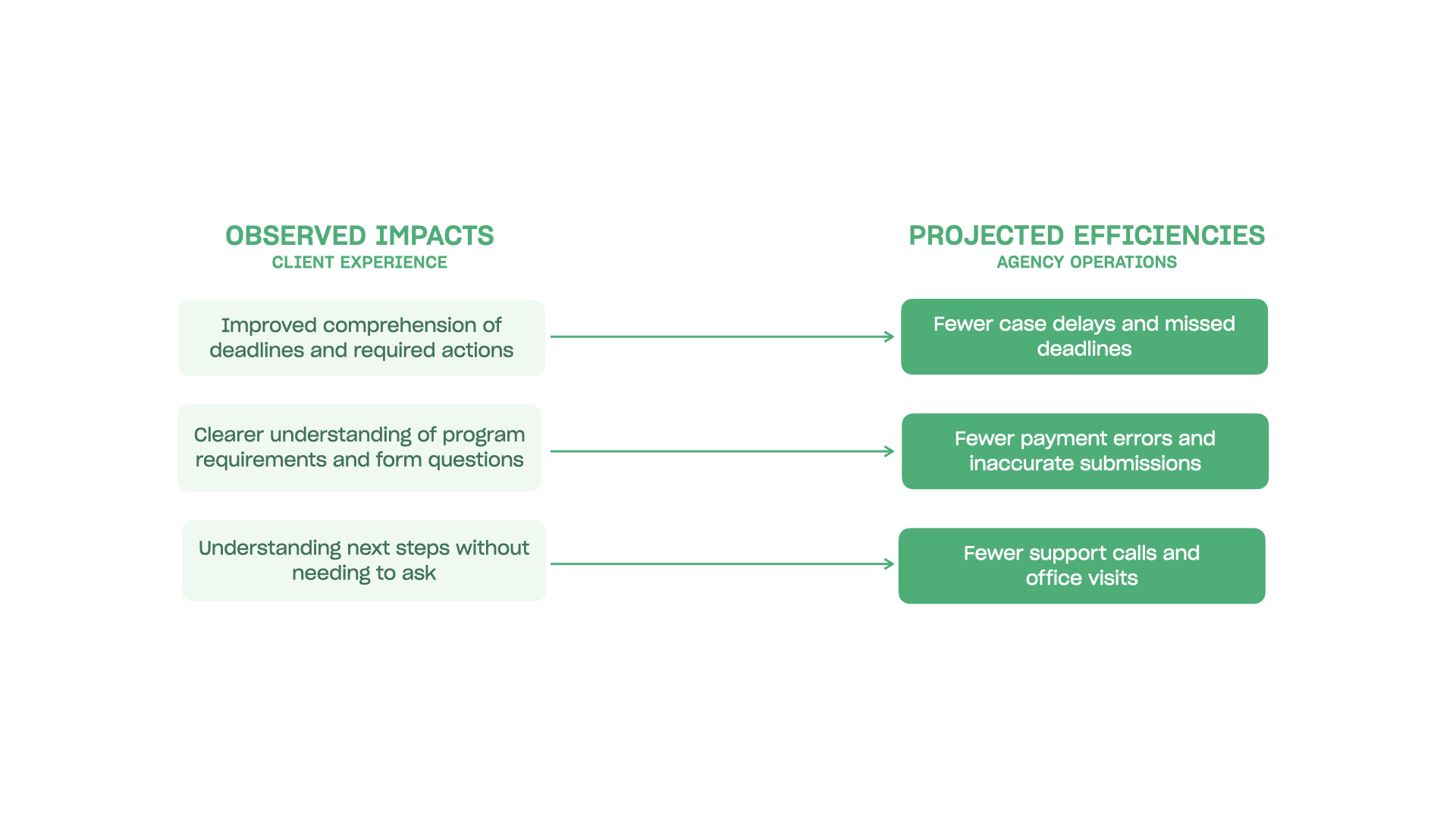
Redesigned notices have the opportunity to support hundreds of thousands of Arizonans who rely on DES programs to put food on the table and care for their families. Improved client comprehension is projected to drive higher response rates and more complete, accurate returns. This means fewer support calls or office visits for questions, freeing up caseworker workload and improving administrative efficiency. For the SNAP program specifically, having more accurate client data from change-reporting forms can help improve accuracy and safeguard the program.
DES is currently reviewing these materials for implementation. In the interim, Public Policy Lab is using what we learned to create CLARA—an AI-assisted tool that helps states generate compliant notices that are understandable to the families who receive them—and to release two modifiable, plain-language templates for SNAP change reporting for use by other states.
PPL is a tax-exempt 501(c)(3)
nonprofit organization.
info@publicpolicylab.org
+1 646 535 6535
20 Jay Street, Suite 203
Brooklyn, NY 11201
We'd love to hear more. Send us a note and we'll be in touch.
Enter your email below to subscribe to our occasional newsletter.
Wondering what you’ve missed?
Check out our
The Public Policy Lab is a tax-exempt
501(c)(3) nonprofit organization.
Donate now to support our work; your
gift is tax-deductible as allowed by law.