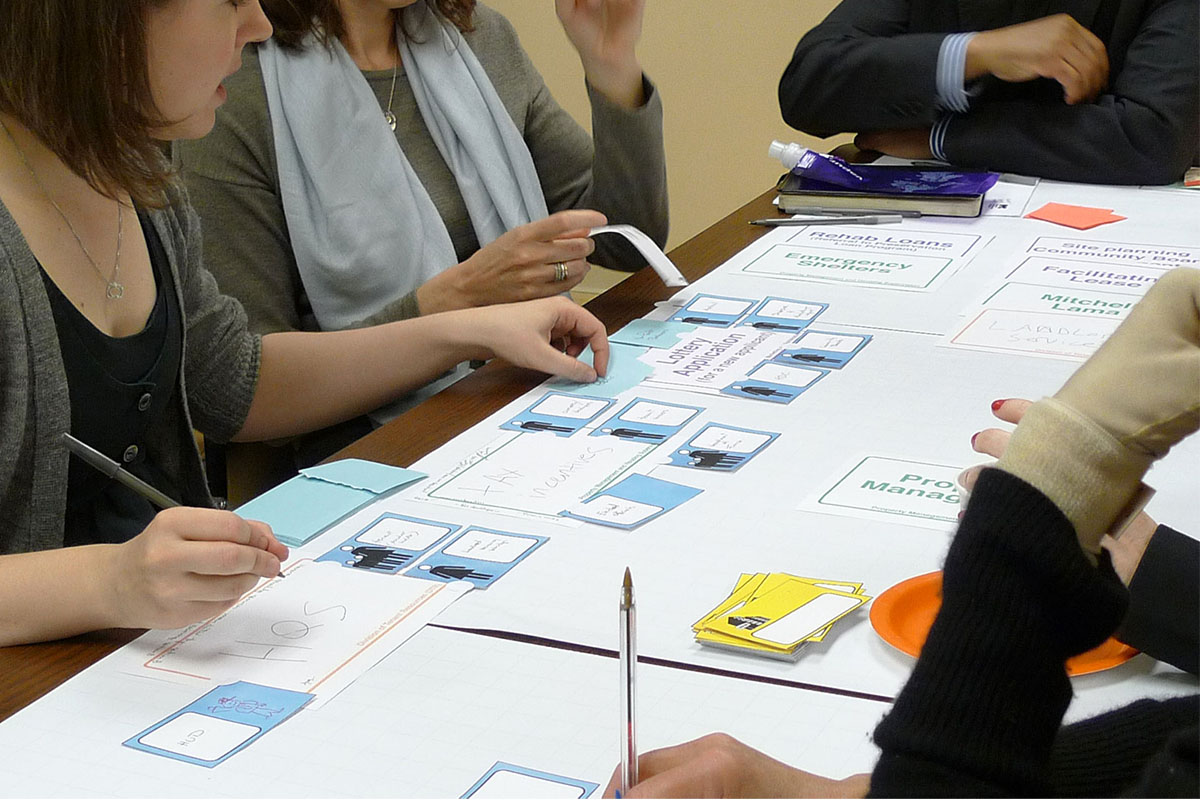
Public & Collaborative: Designing Services for Housing was an innovative collaboration between the NYC Department of Housing Preservation & Development (HPD), the DESIS Lab at Parsons The New School for Design, and the Public Policy Lab. The project was made possible through the generous support of a 2012 New York City Cultural Innovation Fund grant awarded by the Rockefeller Foundation.
The project’s goals were twofold — to assist HPD in delivering more effective, efficient, and satisfying services, and to explore ways to facilitate the involvement of community residents in the development of housing-related services in neighborhoods with significant public- and private-sector investment leveraged by HPD.
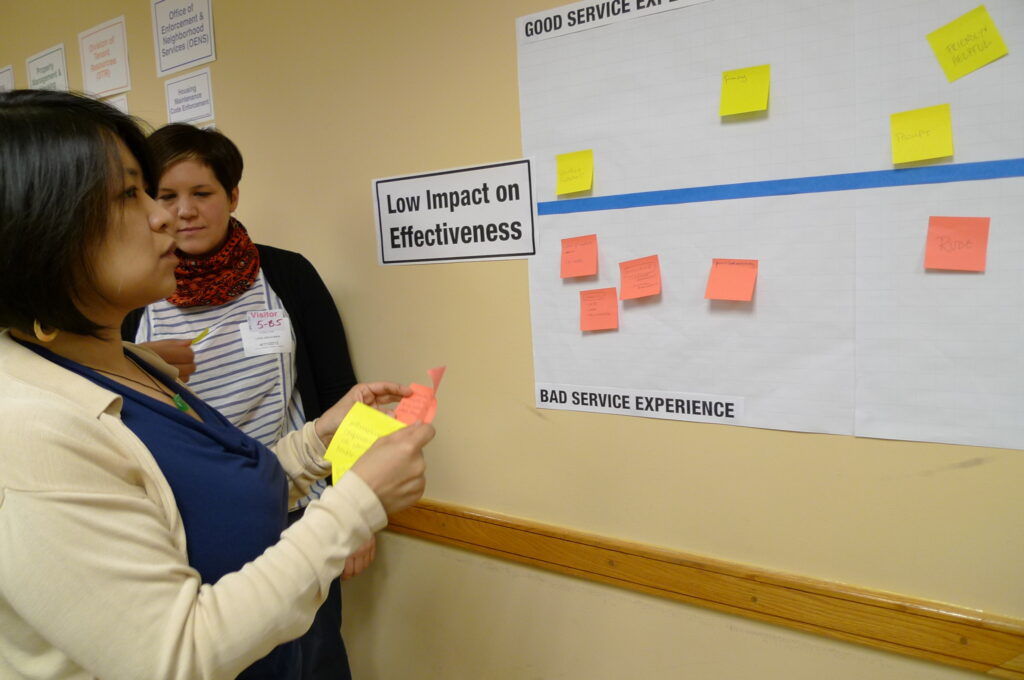
We organized interview sessions and co-design workshops to identify information gaps, areas of confusion, and pain points and opportunities in the application process. Building from research learnings, we co-developed a suite of pilots and supplemental resources to:
1. create new, human-centered informational materials,
2. encourage hyper-local marketing by developers,
3. support community-based housing ambassadors,
4. and form a street team for in-person HPD outreach.
In combination, the pilot activities and materials created a knowledge-sharing infrastructure that enabled dynamic and reciprocal exchange of information between residents, community-based partners, housing developers, and HPD leadership and front-line staff.
Fifteen years later, evolved versions of many of the project materials continue to be used, HPD has a robust in-person outreach team, and the Housing Ambassador program is going strong, with more than four dozen organizations (and growing) helping New Yorkers find affordable homes.
Read the initial Public and Collaborative report here.
Read the Pilot Evaluation report here.
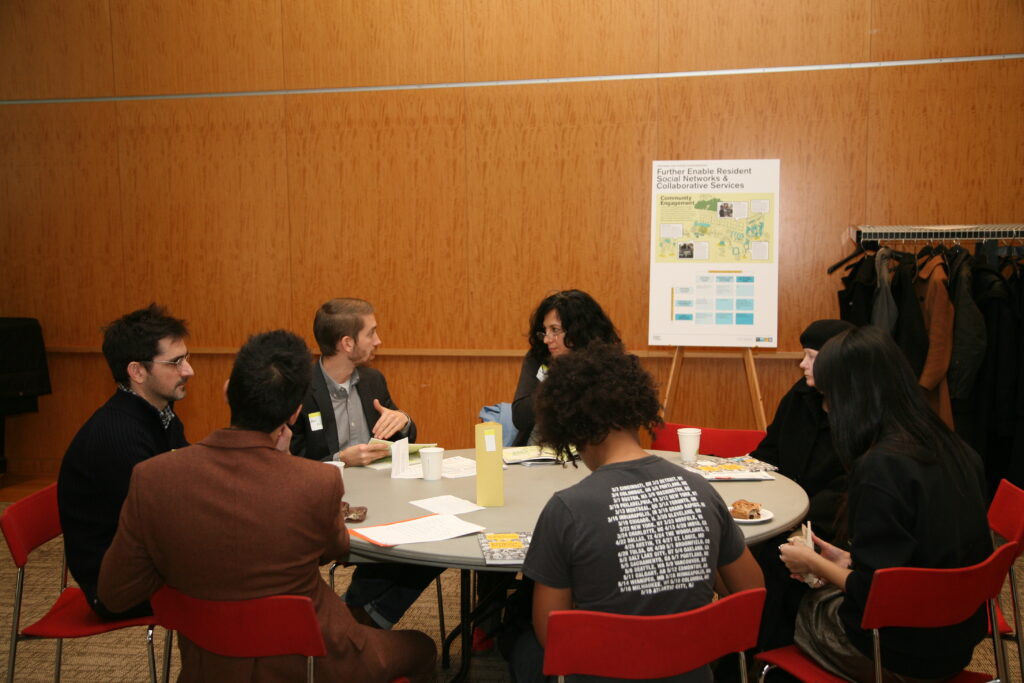
Over the latter half of 2012, the Public Policy Lab conducted research with HPD leadership, front-line agency staff, staff at community-based organizations (CBOs) that offer housing assistance, developers of affordable housing, and current or potential users of the agency’s services.
The team observed HPD service spaces, assessed HPD online interfaces and application materials, conducted an audit of HPD information materials, and assessed affordable housing policy. We conducted site visits to HPD field office in Brooklyn and to HPD-sponsored developments in the Bronx. We facilitated interviews and workshops with developers, community-based organizations, HPD staff, and policymakers. We also conducted on-the-street interviews in Manhattan and the Bronx with several dozen past and potential affordable housing applicants.
Key Findings
Engagements with stakeholders in 2012-2013 revealed a number of challenges then faced by participants in the affordable-housing application process.
In response to the research findings, we developed four pilot proposals. These new services and materials were designed to create a knowledge-sharing infrastructure that enabled dynamic and reciprocal exchange of information among key stakeholders.
Pilot 1: Adopt New, Human-Centered Informational Materials
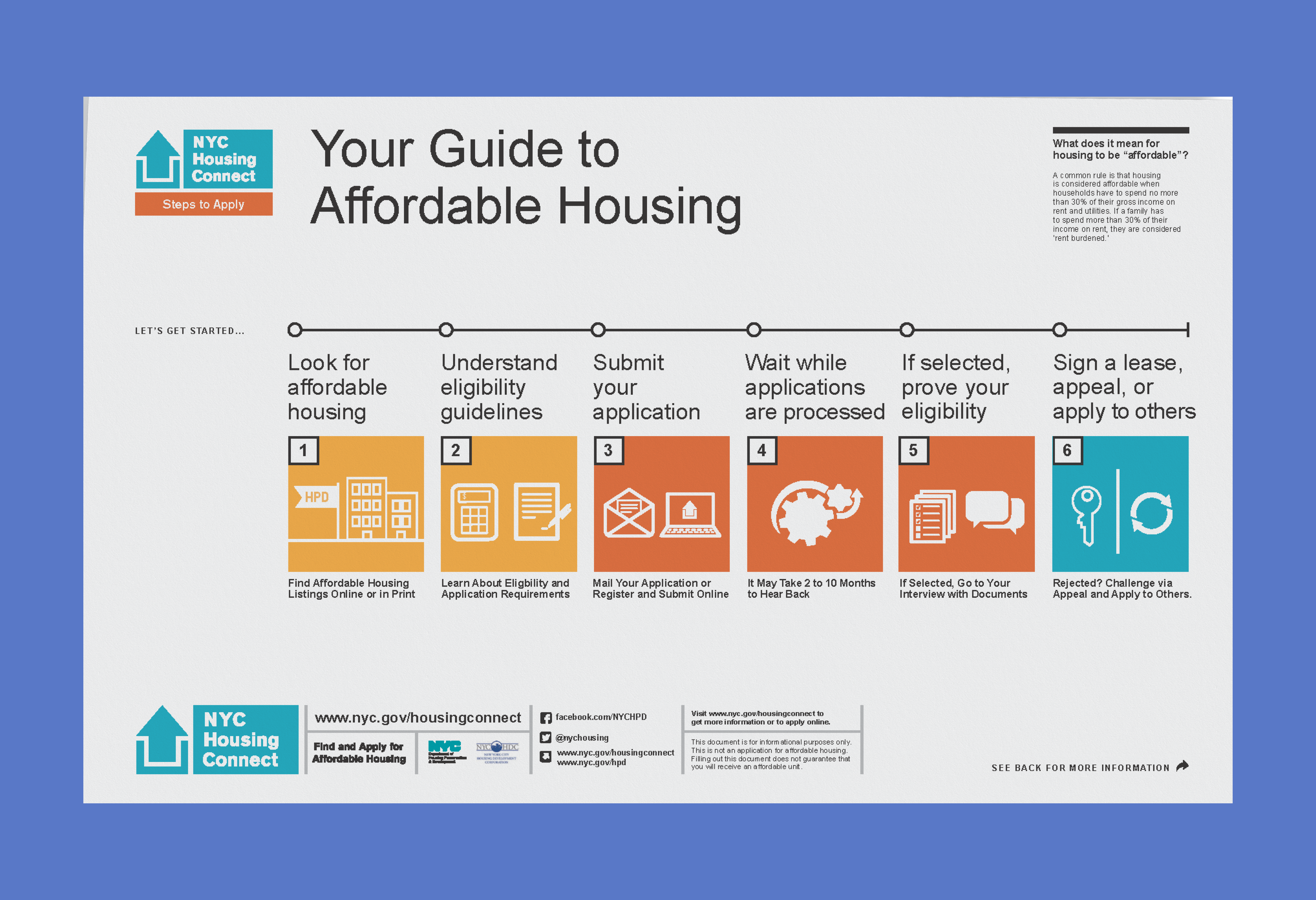
PPL created new informational materials, including a redesigned advertisement template to list information about a specific development, as well as a monthly-listings template that offers information about all available developments citywide. An income guide, application-process map, and a checklists document completed the suite of new HPD-branded informational materials.
Pilots 2 through 4 explored specific distribution channels for the informational materials.
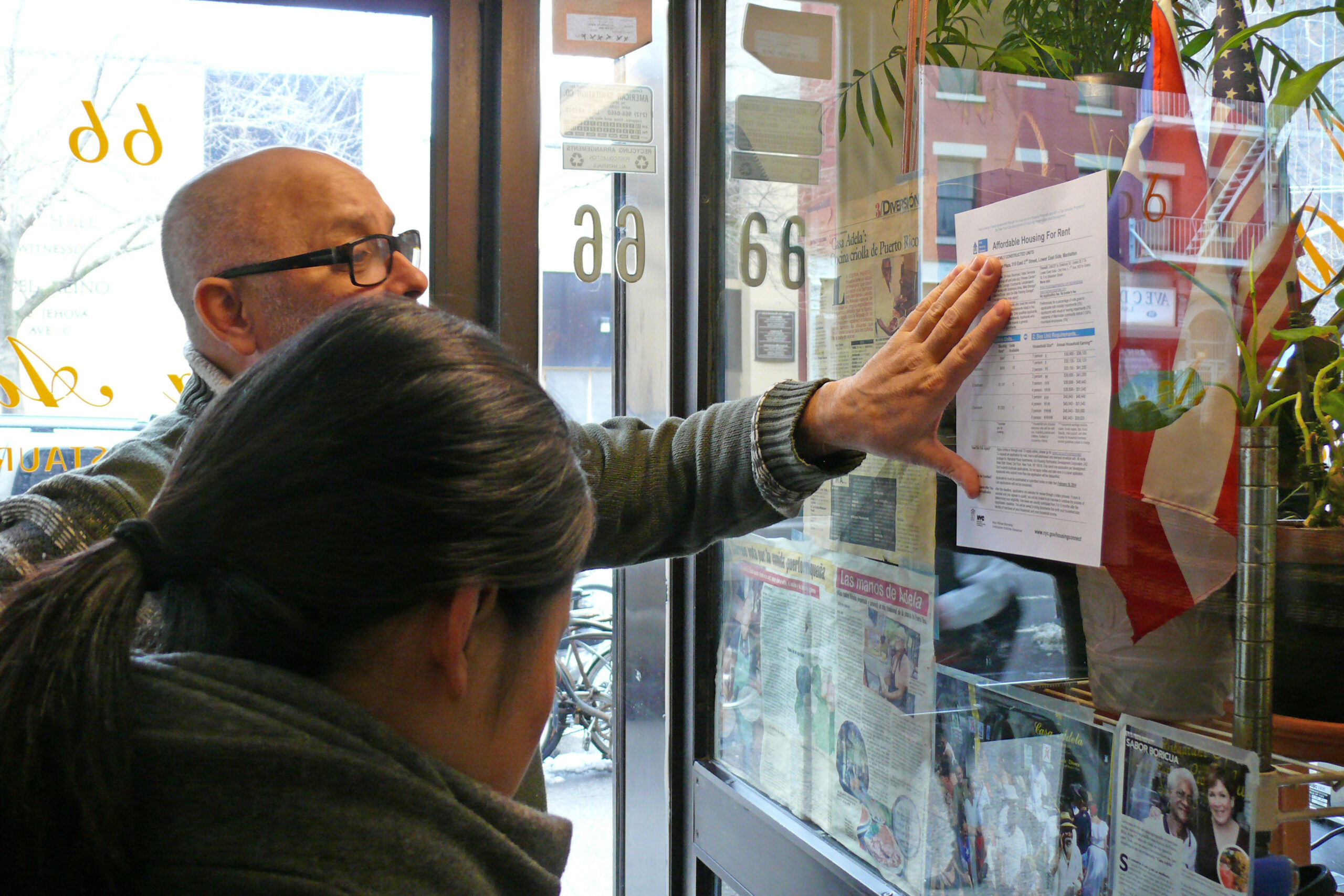
Hyper-local marketing agents posted housing advertisements in everyday settings such as restaurants and laundromats.
Pilot 2: Encourage Hyper-Local Marketing
This pilot suggested that HPD supplement existing outreach by asking developers to share redesigned advertisements (described in Proposal 1, above) in public venues frequented by neighborhood residents, including laundromats, bodegas, and supermarkets, schools, churches, hospitals, gyms, libraries, and transit stations.
By targeting locations frequented by most community members at some point during the average week, more eligible residents could become aware of available units and apply.
Pilot 3: Support Housing Ambassadors
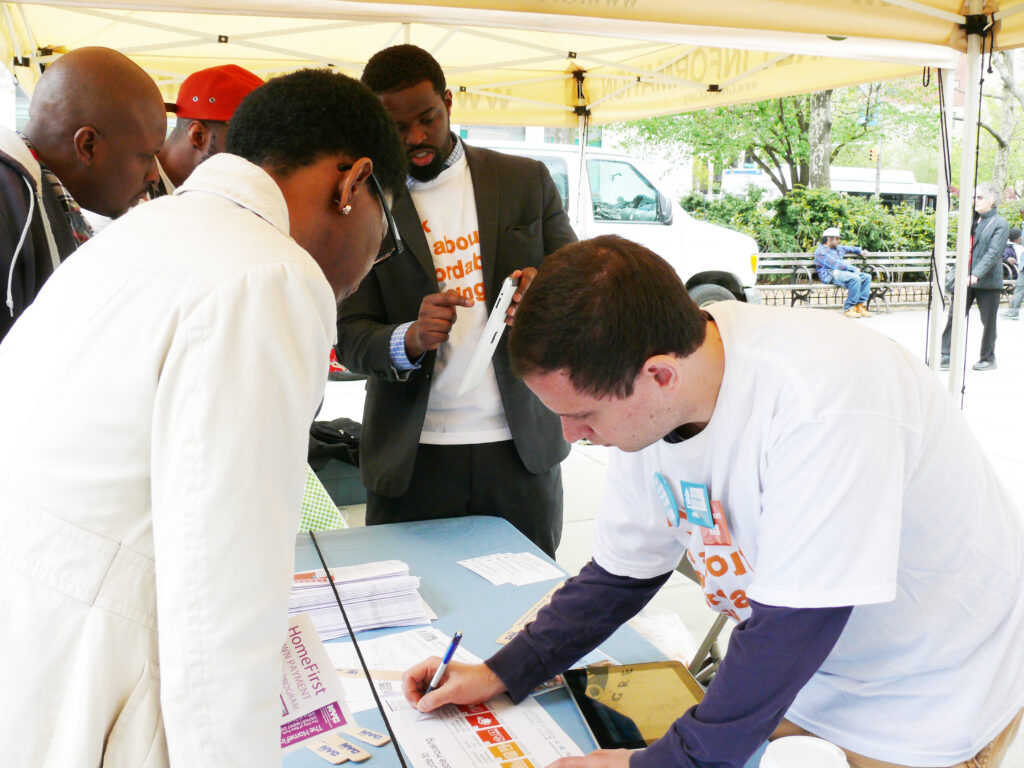
Many individuals and institutions support residents in applying for affordable housing, including neighborhood groups, nonprofit developers, community-based organizations, and many individuals with housing experience who blog about affordable housing, or help neighbors, friends, and family members through the application process. This pilot called for HPD to implement a pilot program, NYC Housing Ambassadors, to support their work by providing reliable resources and training—and to create a pipeline for HPD to learn from these on-the-ground representatives.
Pilot 4: Launch NYC Housing Connect Street Team
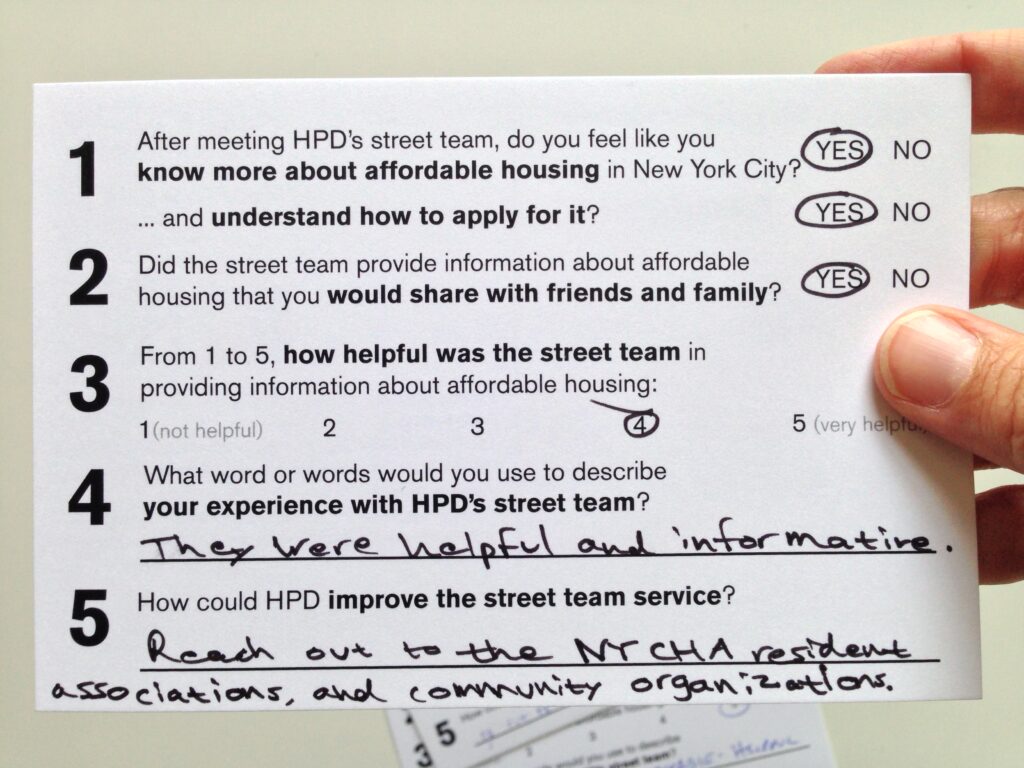
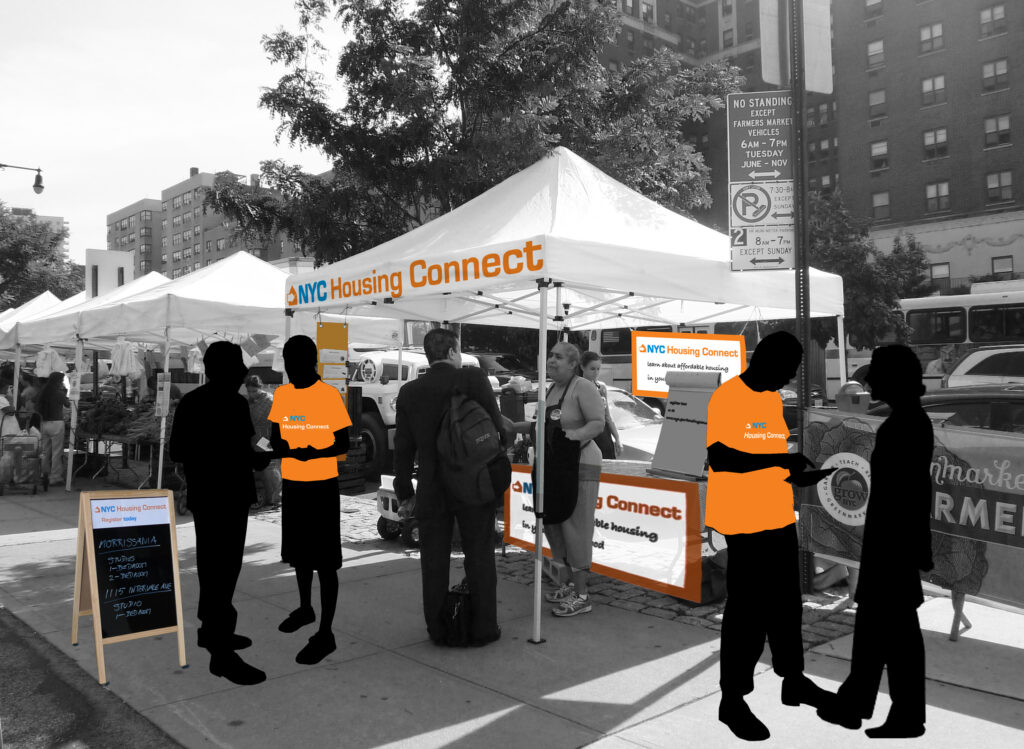
To address the lack of visibility and awareness of many affordable-housing programs, this proposal called for HPD to employ a street team in strategic locations and at specific events to: highlight HPD’s sponsorship of affordable housing, publicize the rollout of the NYC Housing Connect online application portal, and broaden the pool of eligible housing applicants.
Downloads During Pilot
Housing Ambassador Organizations
The four pilots were implemented and evaluated during a pilot phase in late 2013 and early 2014. Using a range of qualitative and quantitative assessments—including results from a survey of nearly 2,500 New Yorkers—the evaluation team looked both at the process by which each of four pilot proposals was implemented and also the outcomes and impacts of those activities. Piloting and evaluation activities took place over 12 months, ending in July 2014.
The evaluation team found that the pilots clearly met the proposals’ stated design objectives: to encourage information accessibility and exchange, account for applicants’ lived reality, and enable more informed decision-making (although findings were somewhat mixed regarding the first of those objectives). The pilots also achieved their intended short-term outcomes, to create stronger support for community groups that provide applicants with assistance and to generate greater access to information about the process.
Piloting revealed that the informational materials and the housing ambassadors programs were particularly effective and suitable for scaling. Informational materials were downloaded more than 350,000 times during the eight-month pilot period. Implementation of the street team and hyper-local marketing proposals was successfully achieved, but the pilots also suggested a need for additional resources or different approaches before the programs were scaled up.
HPD ultimately implemented our informational materials, the current versions of which are featured on their Housing Connect page under Applying for Affordable Housing. Along with the information materials, they also adopted our color and brand kit.
Despite early challenges, the Street Team pilot ultimately inspired a significant change in HPD’s community-outreach activities, including creation of the HPD Outreach Van.
The biggest successes of this project was the adoption and expansion of the Housing Ambassador program across the city. As of 2025, the program includes more than four dozen partner organizations, which help thousands of New Yorkers find housing every year. Learn more about the Housing Ambassador program in the video below.
PPL is a tax-exempt 501(c)(3)
nonprofit organization.
info@publicpolicylab.org
+1 646 535 6535
20 Jay Street, Suite 203
Brooklyn, NY 11201
We'd love to hear more. Send us a note and we'll be in touch.
Enter your email below to subscribe to our occasional newsletter.
Wondering what you’ve missed?
Check out our
The Public Policy Lab is a tax-exempt
501(c)(3) nonprofit organization.
Donate now to support our work; your
gift is tax-deductible as allowed by law.