Responding to President Biden’s executive order on customer experience, PPL partnered with the White House’s Office of Management and Budget and the US Digital Service to conduct qualitative research on how the federal government could better support people facing a financial shock — from job loss and medical bills to housing instability and the death of a loved one.
The Outcome
After speaking with Americans facing financial hardship across the country, the team produced discovery insights and launched three design-phase pilot projects: improving income verification, supporting Medicaid renewals, and streamlining state access to benefits. As a result, over 5 million people have been re-enrolled in Medicaid, saving states more than 2 million hours of caseworker time.
Responding to President Biden’s executive order on customer experience, PPL partnered with the White House’s Office of Management and Budget and the US Digital Service to conduct qualitative research on how the federal government could better support people facing a financial shock — from job loss and medical bills to housing instability and the death of a loved one.
The Outcome
After speaking with Americans facing financial hardship across the country, the team produced discovery insights and launched three design-phase pilot projects: improving income verification, supporting Medicaid renewals, and streamlining state access to benefits. As a result, over 5 million people have been re-enrolled in Medicaid, saving states more than 2 million hours of caseworker time.
Project Background
Millions of American families face financial shocks every year — an unexpected medical bill, the sudden loss of income, a rent increase, or student loans coming out of deferment. For many of these families, a tangled web of information about services, burdensome application processes, and complex payment systems means they miss out on critical support needed to re-establish financial stability.
More than a quarter of eligible people facing a financial shock receive no help from any federally funded program. Benefits Data Trust estimates that across just five programs, more than $60 billion per year in benefits go unclaimed. And even for those who do access benefits, millions waste countless hours and miss important work days navigating the process.
The project team spoke with people nationwide to learn how government services could have been more helpful. Research took place in-person and virtually, in English and in Spanish, across nine states and territories. Participants included people vulnerable to financial shocks, such as low-wage workers.
User Stories
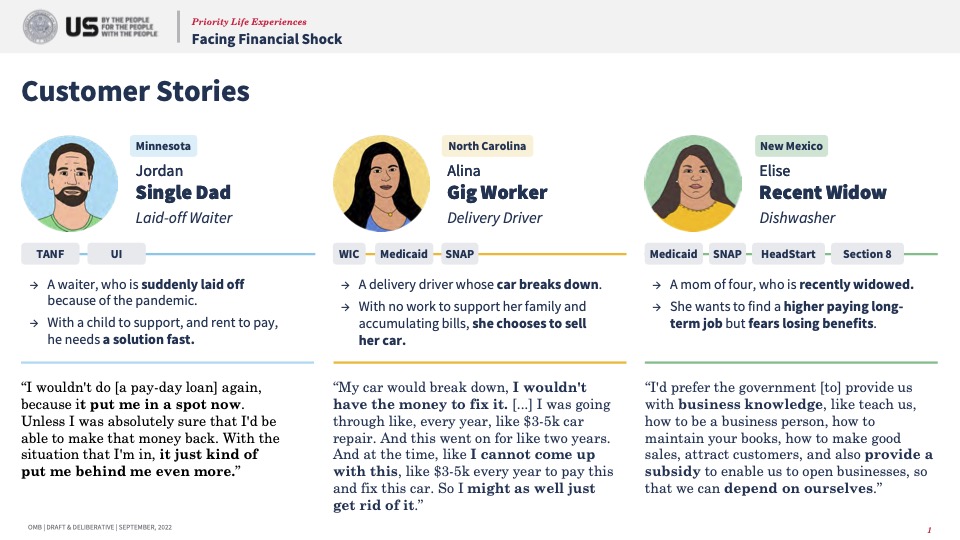
We developed user stories that serve as composite representations of the people we spoke with. The stories come directly from these conversations, but names have been changed.
Sessions captured candid feedback on what could have worked better and what really made a difference. The team identified multiple pain points that could be addressed by federal policymakers:
Disjointed and unpredictable application process. People are asked to provide the same information for different benefits, adding to confusion and drop-off. There is also uncertainty about how long it takes to receive benefits after applying.
Managing essentials while waiting for benefits. Common unexpected shocks — car repairs, home emergencies, health crises — can trigger a financial spiral. Between the shock and receiving benefits, people must make hard choices about which basic needs to prioritize.
Training while working. Navigating education, training, and credential programs that could open pathways to better jobs is overwhelming in moments of financial turmoil, competing directly with the need to work and cover living expenses.
Journey Map Excerpt
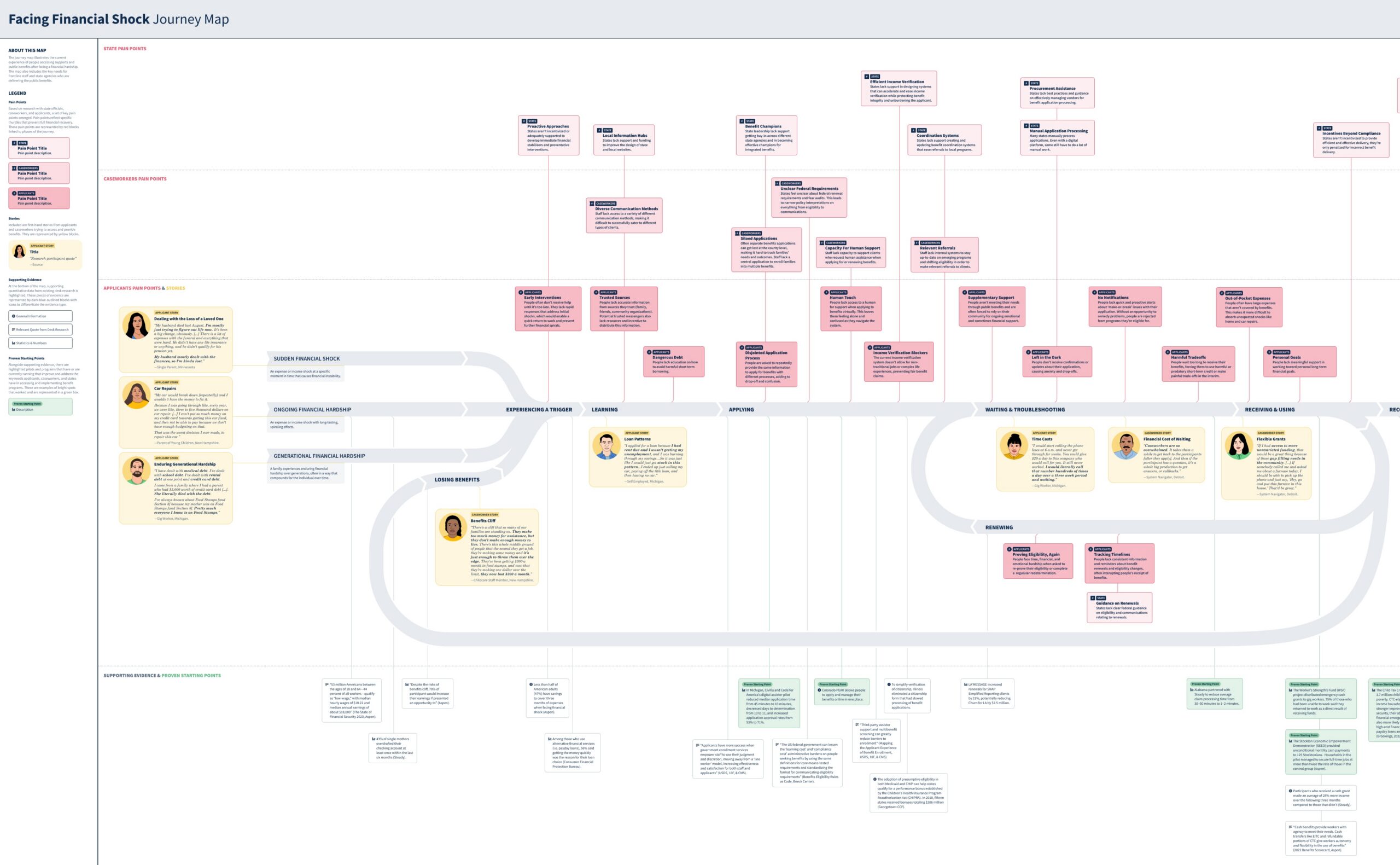
This map illustrates the journey of people accessing supports and public benefits after facing financial hardship. The map also includes the key needs for frontline staff and state agencies who are delivering the public benefits.
What Was Implemented
Using what the team learned during research, they worked with the White House to develop policy and program concepts. In 2024, three of those concepts moved into a piloting phase:
An income verification pilot designing and testing a consent-based tool to reduce the administrative burden of eligibility determinations for Medicaid, SNAP, and TANF — expanding coverage beyond traditional W-2 earners to include gig workers and 1099 earners.
A Medicaid renewals rapid response team providing direct technical assistance to states to identify and fix IT system errors causing erroneous coverage losses at the end of the national Public Health Emergency.
A Supporting States initiative convening benefits leaders from 30 states monthly to share best practices in benefits delivery, including plain language, text messaging, data sharing, and automation.
These projects are continuing to be tested and expanded. Over 5 million people have been re-enrolled in Medicaid as a result of the rapid response work, saving states more than 2 million hours of caseworker time. The income verification prototype has shown promising early results, with reduced time for individuals to complete verification and decreased caseworker workload.