Domestic violence (DV) is a pervasive issue impacting individual and community safety. Unlike with other forms of violence, the City of Chicago has not historically focused on reducing intimate partner violence at its root. This initiative aims to establish regional coordination and develop insights and materials to connect people who cause harm to suitable, voluntary violence intervention and stabilizing services.
The Outcome
A sustainable voluntary intervention system for PWCH, with a focus on 1) supporting referral pathways and coordination and 2) informing programming that is contextually appropriate and responsive to service-user needs and retention.
Project Background
In early 2025, the Michael Reese Health Trust published a landscape scan report that identified a need for more voluntary resources for people who cause harm (PWCH) in Chicago. These resources are being requested by PWCH who are concerned about their behavior, as well as by their loved ones. The report noted that Illinois’ Domestic Violence Hotline, run by The Network, receives up to 100 unprompted calls a year for this purpose.
In response, The Network is developing hotline agent protocols and training for such calls, and the Chicago Department of Family & Support Services (DFSS)‘s Division of Gender-Based Violence is funding voluntary programming.
While some existing violence intervention programs have demonstrated anecdotal success, these programs focus heavily on court-mandated participants. Some non-court-mandated PWCH do attend these programs, but spaces are limited and the format is not always appropriate for those participating voluntarily.
Knowledge and outreach regarding intimate partner violence intervention programming are also limited within Chicago. This project aims to identify key stakeholders, support regional coordination, and develop materials to help frontline staff or those in less formal roles refer willing PWCH to programs. Ultimately, the goal of this work is to reduce instances of domestic violence and provide more options to support survivors and potential survivors who are concerned about their partners’ behaviors.
Project Approach
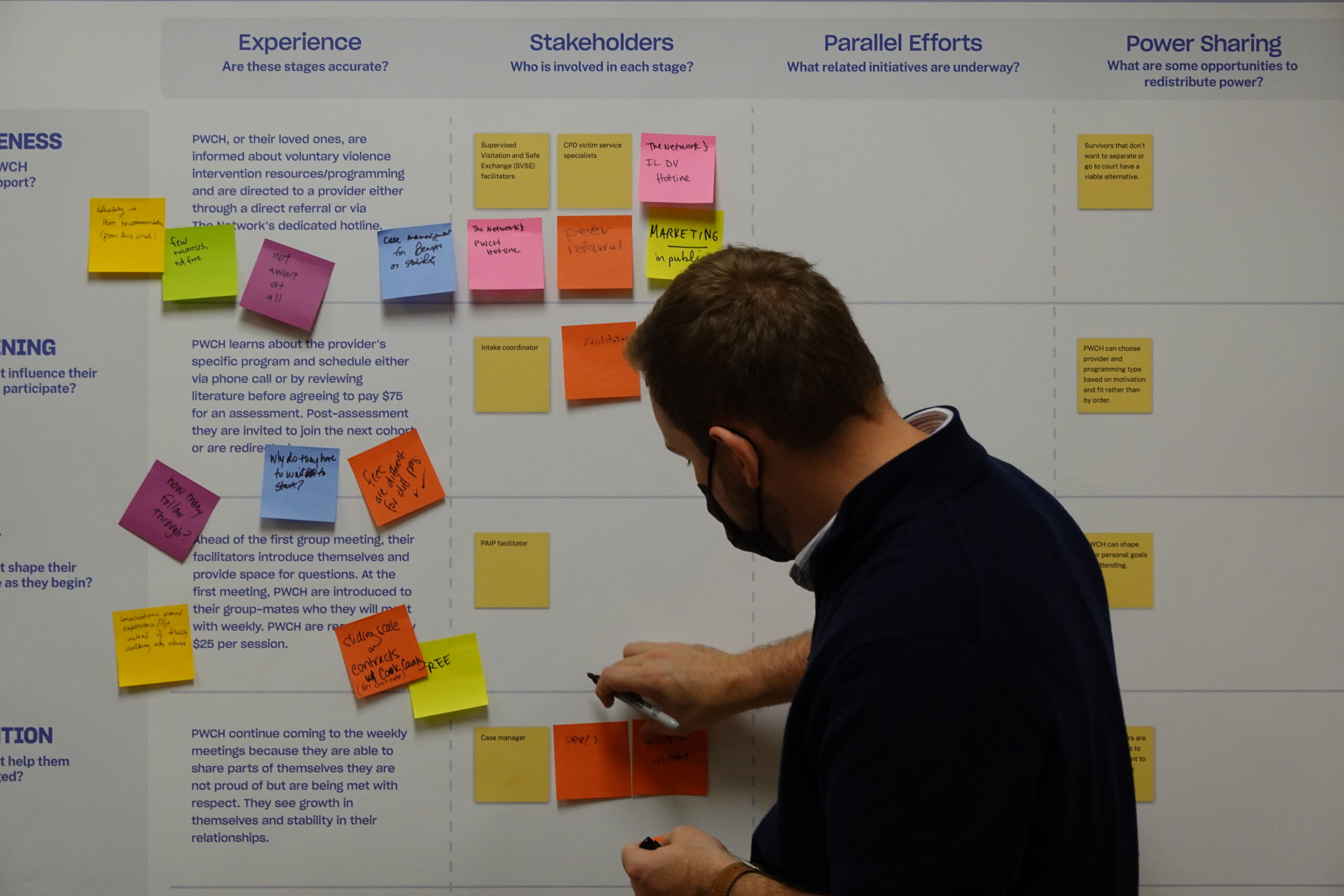
The PPL team is currently conducting qualitative research with current and potential service users, survivors, existing program facilitators, subject matter experts, and potential referral sources.
Learning Goals:
How is behavior change cultivated and supported, with a particular focus on violence intervention programs?
How can organizations, programs, and those who interact with PWCH coordinate to connect them to support?
What are the needs and wants of PWCH, those they harm, and those who interact with them when considering voluntary support, and what hesitations keep them from seeking it?
This research will continue through late November. The team will generate concepts and co-design interventions from late November until mid-February.