

The City of New York believes that digital technologies have the potential to transform lives—to help all New Yorkers achieve a healthy life, a good education, rewarding work, and a secure retirement. All New Yorkers, particularly those who live around the poverty line, use technology to access important services.
In 2016, the NYC Mayor’s Office of Digital Strategy set out to transform how the City of New York delivers services to its residents. Recognizing that digital access and service design were increasingly central to the everyday lives of New Yorkers—and that the gap between what the City offered and what residents actually needed was wide—the Mayor’s Office partnered with Bennett Midland, Bureau Blank, and the Public Policy Lab (PPL) to develop the NYC Digital Playbook. The Playbook was conceived as a living framework to guide city agencies in building more equitable, accessible, and human-centered digital services. It was formally launched in May 2016.
PPL joined the project team to lead discovery research—a phase of deep, human-centered inquiry to understand the real needs and experiences of New Yorkers. The findings from this research became the evidentiary foundation for the Playbook’s guiding principles and strategies, providing the City with an empirical basis for redesigning how digital services are imagined, built, and delivered across agencies.
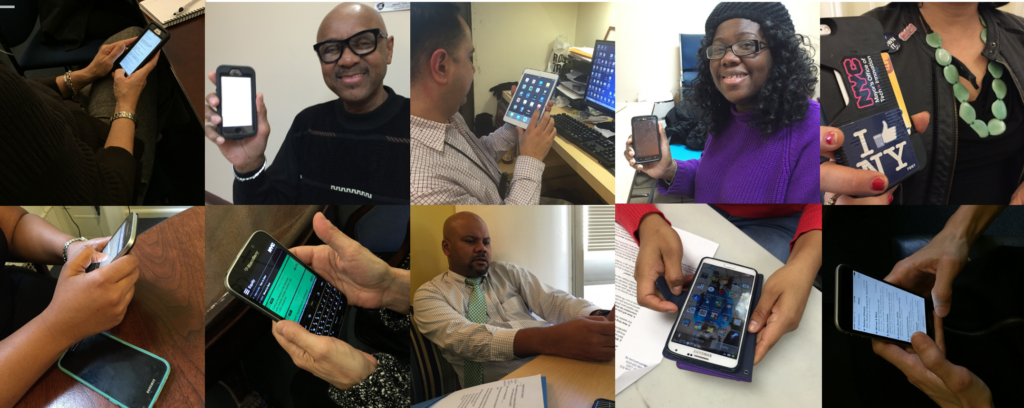
The team met with dozens of New Yorkers, who told us about their service experiences and their digital lives.
Research Participants
Boroughs
Our team used a human-centered design approach to conduct discovery research across the five boroughs. We met with New Yorkers to understand their day-to-day experiences with City services and digital tools. The team conducted 26 in-depth interviews with city residents from diverse racial, economic, linguistic, and geographic backgrounds, engaging New Yorkers earning under $25,000 a year as well as those earning over $100,000, and speakers of languages other than English. Alongside residents, we spoke with 23 City employees across a range of agencies—including the Department of Finance, the Human Resources Administration, the Mayor’s Office of Immigrant Affairs, and others—and 26 civic tech experts from organizations spanning government innovation, public interest technology, and community advocacy.
To make sense of the hundreds of insights gathered, the team held research pin-up sessions where findings from the ethnographic interviews were shared with City leaders for feedback and synthesis. This collaborative sense-making process helped the team distill themes from across three lenses: human experiences (how New Yorkers live and feel), service experiences (how services are delivered), and institutional experiences (how the City’s internal systems operate). Together, these findings generated the fuel for the Playbook’s principles and strategies.
Inquiry Areas
Our research was organized around distinct questions for each participant group. With residents, we asked: How do New Yorkers currently find and access City services — and what makes those experiences easy or frustrating? What channels do they prefer, and why? With City leaders and staff, we explored: What is working and what isn’t in building and maintaining digital services? What institutional barriers stand in the way? With civic tech experts, we asked: What principles and strategies should anchor the City’s digital future — especially for residents with the least access? And across all three groups: What does excellent digital service delivery look like, and where does New York City fall short?
What We Heard
Across our conversations with residents, we heard consistently that time and money scarcity shape how people engage with City services. New Yorkers with the least margin in their lives bore the heaviest burden when services were hard to find, difficult to navigate, or required multiple in-person visits. Complex language, opaque processes, and a lack of proactive outreach contributed to cognitive overload, causing some residents to give up before accessing the help they needed. Many were unaware of services they were eligible for, and inconsistent information across City websites made it hard to get reliable answers. Some residents — particularly immigrants and communities of color — also expressed wariness about sharing personal information with the government, and community-based organizations played an outsized role as cultural and linguistic navigators for those who couldn’t or didn’t want to interact directly with City systems.
From City staff and civic tech experts, we heard about the structural challenges undermining service delivery from within. Incompatible back-end systems made coordination between agencies difficult, and inconsistent design standards meant the digital experience varied widely depending on which agency a resident encountered. Staff who lacked tools, training, or authority were less able to design and implement innovative solutions — even when they understood clearly what residents needed.
We also heard about what was working. The City’s 311 phone line and app were cited as examples of resident-centered service with a genuine customer-service culture — a model that could be extended to other agencies. Residents and experts alike pointed to social media, search engines, and mobile-first design as promising channels to meet New Yorkers where they already were. And nearly universal mobile phone ownership opened a practical pathway: text messaging, in particular, was seen as a viable and preferred channel for reaching residents without smartphones or consistent internet access.
It’s not fair, we are being deprived of information that everyone else can access. And it’s such a struggle to gain that access. Being visually impaired, we have to adapt to a sighted world.”
—NYC resident, Upper East Side
Building directly on the research findings, the Playbook team translated insights into a coherent framework to guide future digital service development across City agencies. The NYC Digital Playbook defines six core principles intended to anchor all City digital efforts: Welcome All New Yorkers; Make Government Simple; Listen and Respond; Reach People Where They Are; Protect New Yorkers’ Trust; and Build Collaboration. Each principle reflects what residents told us they needed—dignified access regardless of language or ability, services that recognize and reach out to them proactively, reliable and accountable systems, and a government willing to involve residents in building what serves them.
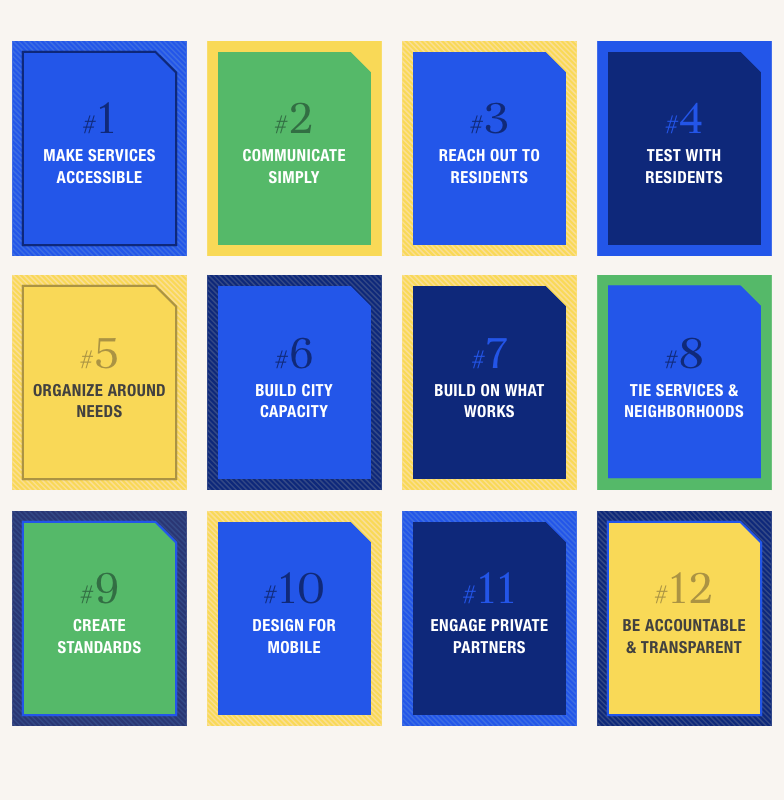
Alongside these principles, the Playbook identifies 12 concrete strategies that agencies can use to develop new or improved services. These strategies move from high-level aspiration to actionable guidance—covering everything from designing for mobile devices first and communicating in plain language, to structuring services around residents’ needs rather than agency structures, collaborating with civic and technology partners, and creating shared technical and design standards across the City. The strategies were designed to be adaptable across a range of contexts and agency types, recognizing that different agencies had different starting points and capacities.
The Digital Playbook identifies 12 specific strategies that City agencies can use to develop new or improved services that meet the City’s core principles for digital services.
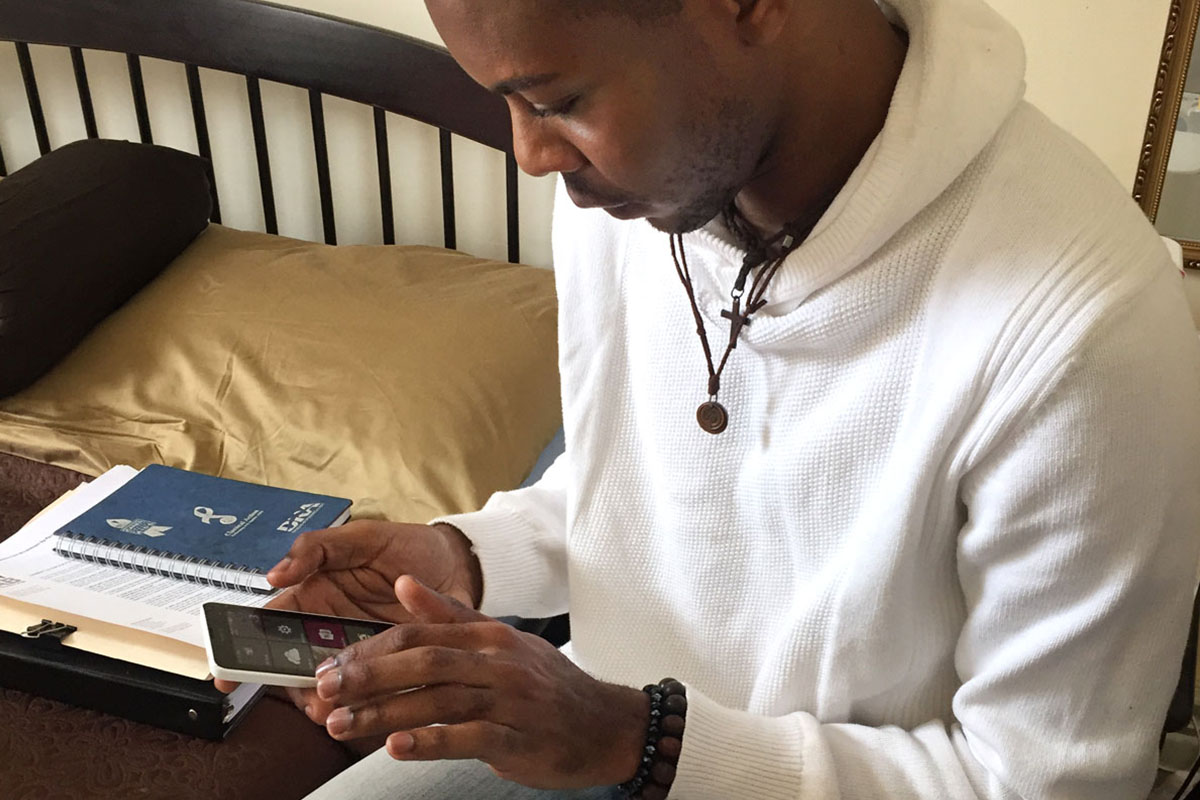
The design of the Playbook was itself shaped by the research process. The team’s direct engagement with residents—meeting them in their homes and listening closely to how they experienced City services—ensured that the Playbook’s recommendations were grounded in real needs rather than assumed ones. The findings made clear that there was no single New Yorker: the framework had to hold space for the full diversity of the city’s population, including those most often left behind by digital transformation efforts. The Playbook was published as a printed document and made available online, intended as a living resource that City staff and civic technologists could continue to reference and build upon.
The NYC Digital Playbook was officially launched by the Mayor’s Office of Digital Strategy in May 2016 and made publicly available both as a printed publication and online. The Playbook—including its six principles and 12 strategies—was disseminated to City agency staff as a guide for improving digital service delivery across New York City’s diverse agencies and departments. The accompanying online platform provided an evolving set of methods for City staff and civic technologists to develop human-centered municipal services, extending the reach of the Playbook’s guidance beyond its print form.
The research findings, entitled New Yorkers’ Digital Service Needs, served as a stand-alone public record documenting the voices and experiences of dozens of New Yorkers and providing a transparent rationale for the principles and strategies the City committed to. Together, the research report and the Playbook established a new baseline for how New York City approaches digital service design: one rooted in resident experience, equity, and the recognition that the best services are built with—not just for—the people they serve. The NYC Digital Playbook continues to serve as the reference for the City’s digital strategy today.
PPL is a tax-exempt 501(c)(3)
nonprofit organization.
info@publicpolicylab.org
+1 646 535 6535
20 Jay Street, Suite 203
Brooklyn, NY 11201
We'd love to hear more. Send us a note and we'll be in touch.
We are accepting applications for a Graduate Summer Intern until February 23, 2026.
To hear about future job announcements, follow us on Instagram, Twitter, Threads, and LinkedIn or subscribe to our newsletter.
Enter your email below to subscribe to our occasional newsletter.
Wondering what you’ve missed?
Check out our
The Public Policy Lab is a tax-exempt
501(c)(3) nonprofit organization.
Donate now to support our work; your
gift is tax-deductible as allowed by law.