

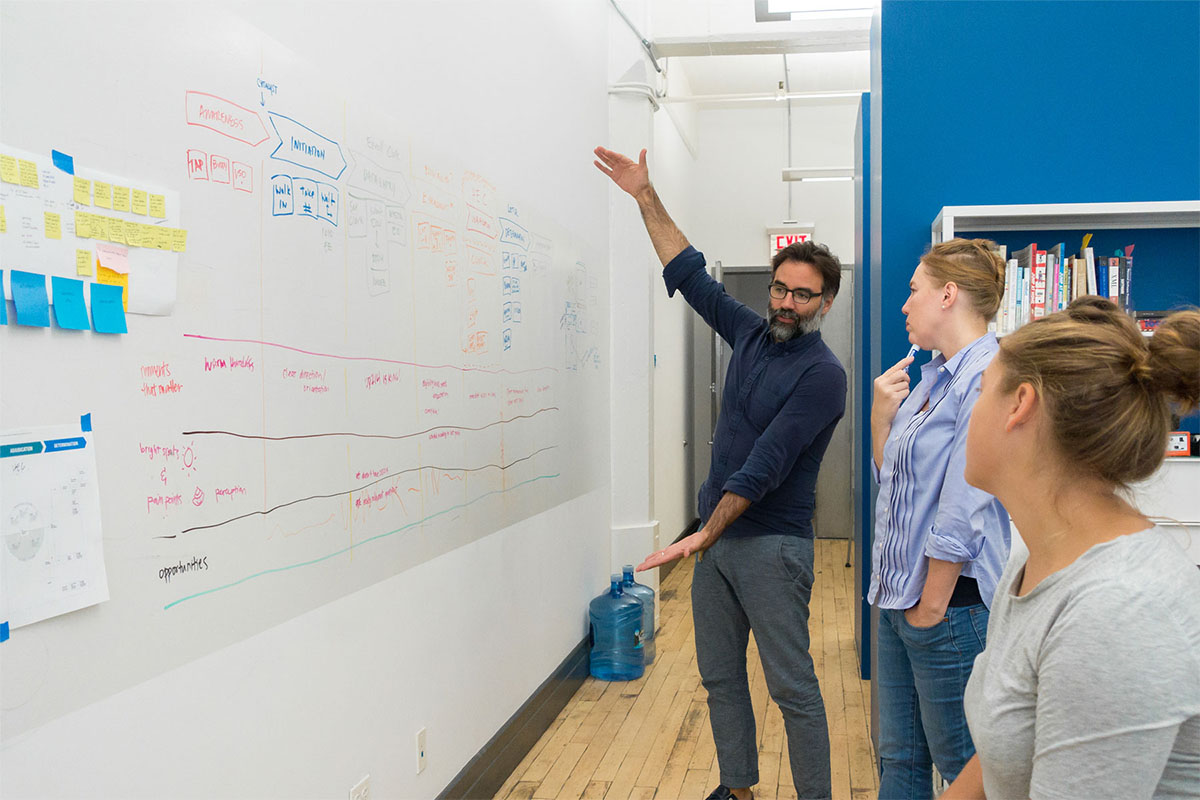
As America’s largest integrated health system, the Veterans Health Administration (VHA) provides essential care to approximately 9 million veterans each year. Veterans can apply for health benefits through five channels — online, by phone, by mail, by fax, or in person at a VA Medical Center (VAMC) — but approximately 70% choose to enroll in person. While the other four channels are monitored by the VHA’s Health Eligibility Center (HEC) using centralized systems, in-person enrollment is managed independently by individual VAMCs, creating inconsistencies in the experience.
PPL partnered with the VA’s Veterans Experience Office and Atlas Research to explore why so many veterans prefer to enroll in person, how a shift to centralized enrollment systems might affect veterans and staff, and what opportunities there might be to improve the overall enrollment process. The team conducted research across six facilities in New York City, Atlanta, and Topeka. They engaged 34 participants, including veterans, frontline staff, and subject matter experts.
Participants
Facilities (VAMCs and Call Centers)
Research with veterans and staff generated key insights about the enrollment experience:
Veterans often don’t learn about VA health benefits through official military transition channels — they hear from friends, recruiters, or VSO representatives, who typically encourage them to enroll in person. Rather than arriving to “enroll,” veterans come to see the facility, ask questions, and understand what the VA can offer them. Enrollment is often triggered not by military separation, but by a life event years later — a health issue, college enrollment, or impending retirement.
Once inside, veterans are generally satisfied. They trust knowledgeable staff to navigate complex forms on their behalf and appreciate the private, personal attention. However, significant frustrations arise when veterans attempt to switch channels mid-process and have to start over, when they leave without a provider assignment or ID photo, or when they receive no follow-up on pending applications — despite VA’s belief that all pending cases are being tracked and contacted.
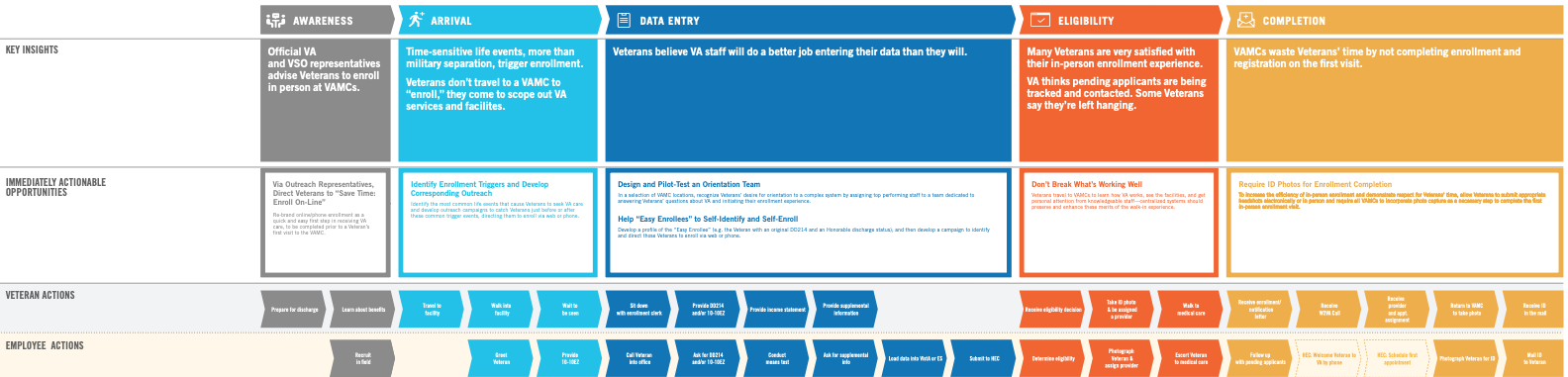
Walk-In Enrollment Experience Journey Map
This journey map represents the steps that Veterans and VA Medical Center staff take in the enrollment process, along with associated bright spots and pain points. View the full journey map here.
The team produced a Walk-In Enrollment Experience Journey Map — a large-format printed poster and digital file — capturing the actions, pain points, and bright spots of both veterans and VAMC staff across all five phases of enrollment. The map also documented opportunities for improvement across three timeframes.
Immediately actionable opportunities:
Medium-term opportunities:
Longer-term opportunities:
PPL delivered its findings — including the journey map and the full Customer Findings and Insights Report — to the VA’s Veterans Experience Office. The report and map were designed for immediate use by VA leadership, enrollment staff, and system designers working to centralize enrollment protocols across VAMCs nationwide. These artifacts helped inform strategic decisions around the enrollment process–preserving the highlights of the in-person experience while reducing inconsistencies for the millions of veterans who rely on VA health care.
PPL is a tax-exempt 501(c)(3)
nonprofit organization.
info@publicpolicylab.org
+1 646 535 6535
20 Jay Street, Suite 203
Brooklyn, NY 11201
We'd love to hear more. Send us a note and we'll be in touch.
Enter your email below to subscribe to our occasional newsletter.
Wondering what you’ve missed?
Check out our
The Public Policy Lab is a tax-exempt
501(c)(3) nonprofit organization.
Donate now to support our work; your
gift is tax-deductible as allowed by law.