

Veterans seeking mental health care must navigate complex intake processes that place the burden of knowing what help to request on the patient. For the U.S. Department of Veterans Affairs’ VA Center for Innovation, PPL researched veterans’ experiences accessing VA mental health services and designed recommendations to improve the access experience across all stages of care.
We provided recommendations for how to improve access to care across three timeframes. Recommendations included redesigning intake screening forms to be safe and easy; pilot projects, such as PreCheck Veterans for mental healthcare; and system transformations, such as reimagining safe screening and intake processes.
Veterans seeking mental health care must navigate complex intake processes that place the burden of knowing what help to request on the patient. For the U.S. Department of Veterans Affairs’ VA Center for Innovation, PPL researched veterans’ experiences accessing VA mental health services and designed recommendations to improve the access experience across all stages of care.
We provided recommendations for how to improve access to care across three timeframes. Recommendations included redesigning intake screening forms to be safe and easy; pilot projects, such as PreCheck Veterans for mental healthcare; and system transformations, such as reimagining safe screening and intake processes.
It can take years for a veteran to reach the turning point when they decide to seek mental health care. But it only takes one moment — an unanswered phone, a curt receptionist, a confusing form — to make someone in need give up. Once veterans acknowledge they need help, they face a system that requires them to navigate complex forms, clinical terminology, and multi-step referral processes that would be difficult to comprehend even without a struggling psyche. VA’s additional requirements, from eligibility screening to Compensation & Pension exams, create further barriers at every stage.
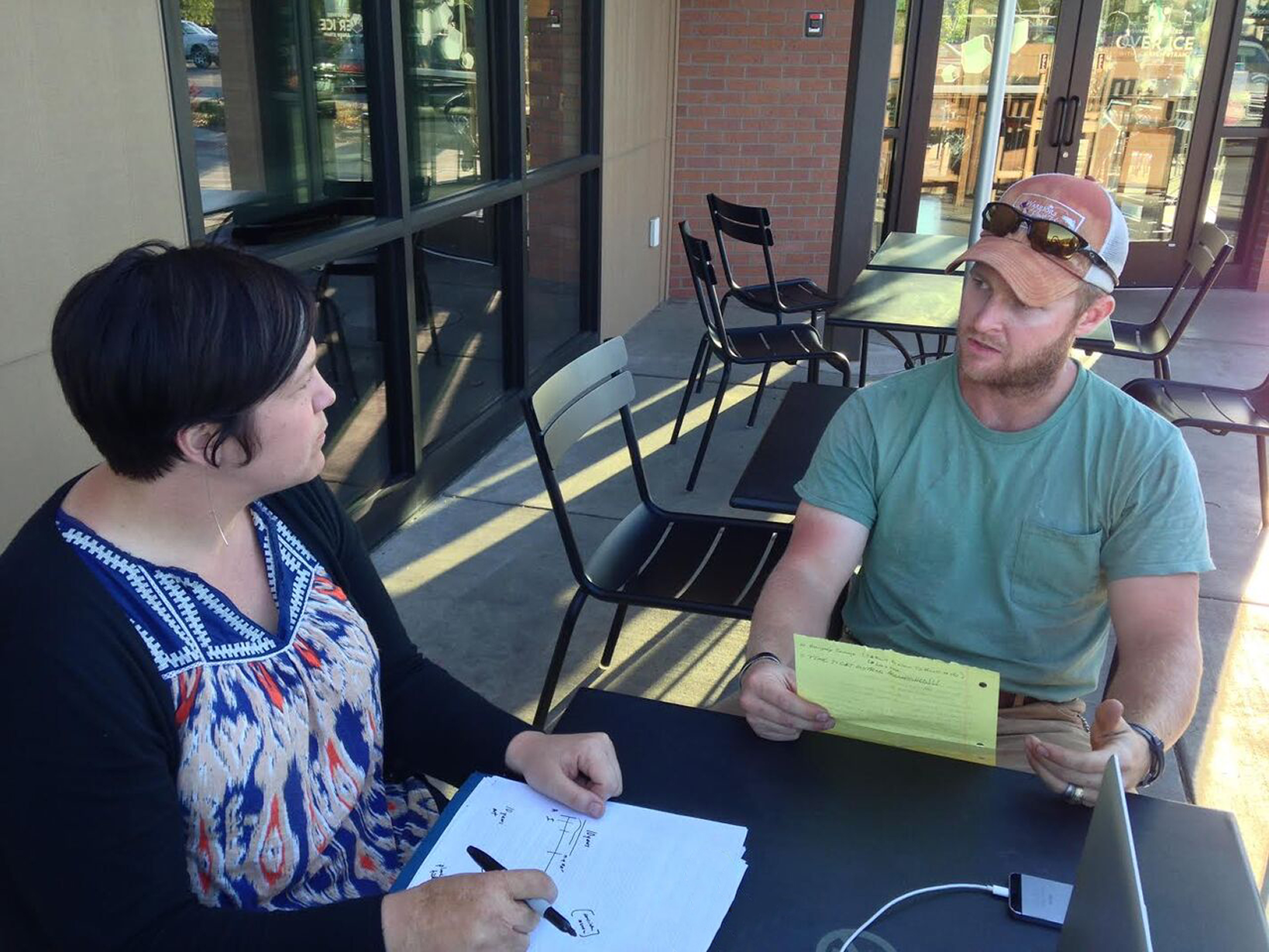
Veterans often laud the quality of VA care once it’s delivered but a variety of challenges cause many to turn away before reaching that point. PPL partnered with the VA Center for Innovation to conduct a human-centered research study into veterans’ journeys to mental healthcare — from the point when they decide to seek help, to the path of actually receiving care. The goal was to surface actionable opportunities for improving access, grounded in the real experiences of veterans and their families.
Veterans who participated in research

Interviews conducted
States visited
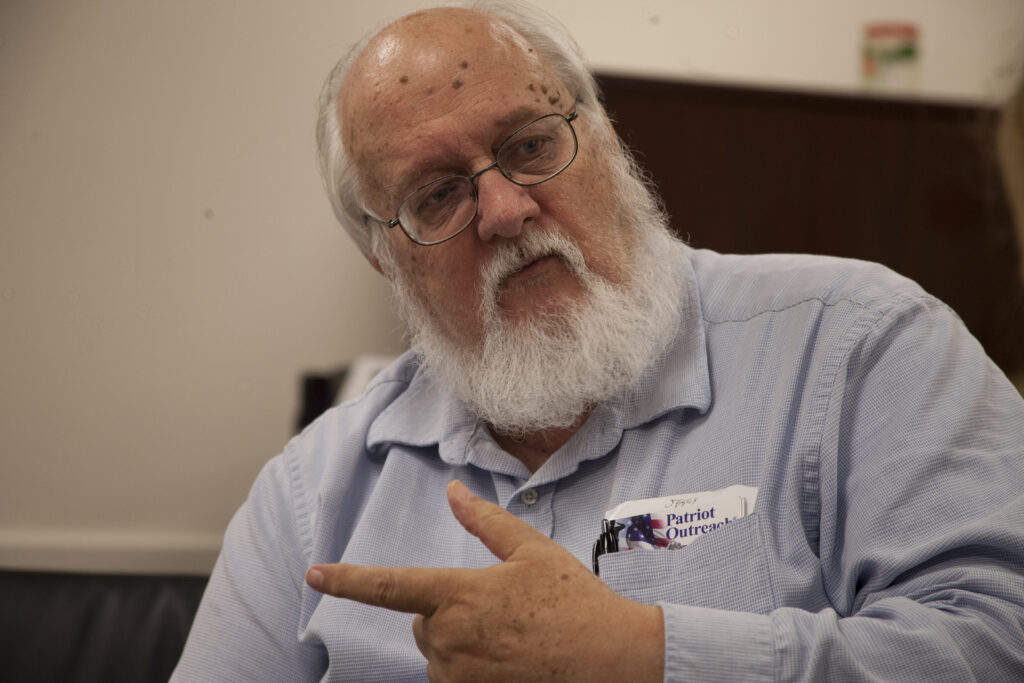
The team traveled across five states, speaking with more than five dozen individuals: veterans, veteran supporters and family members, frontline VA staff and private-sector providers, and subject-matter experts in mental health and healthcare policy. We spoke to veterans in all branches of service, across all service eras from Vietnam to the present, and from a diverse range of ages, geographies, and socioeconomic backgrounds.
Our discussions with veterans, their families, and frontline staff pointed to four needs shared across all stakeholders in the mental healthcare system: clarity, continuity, community, and confidentiality.
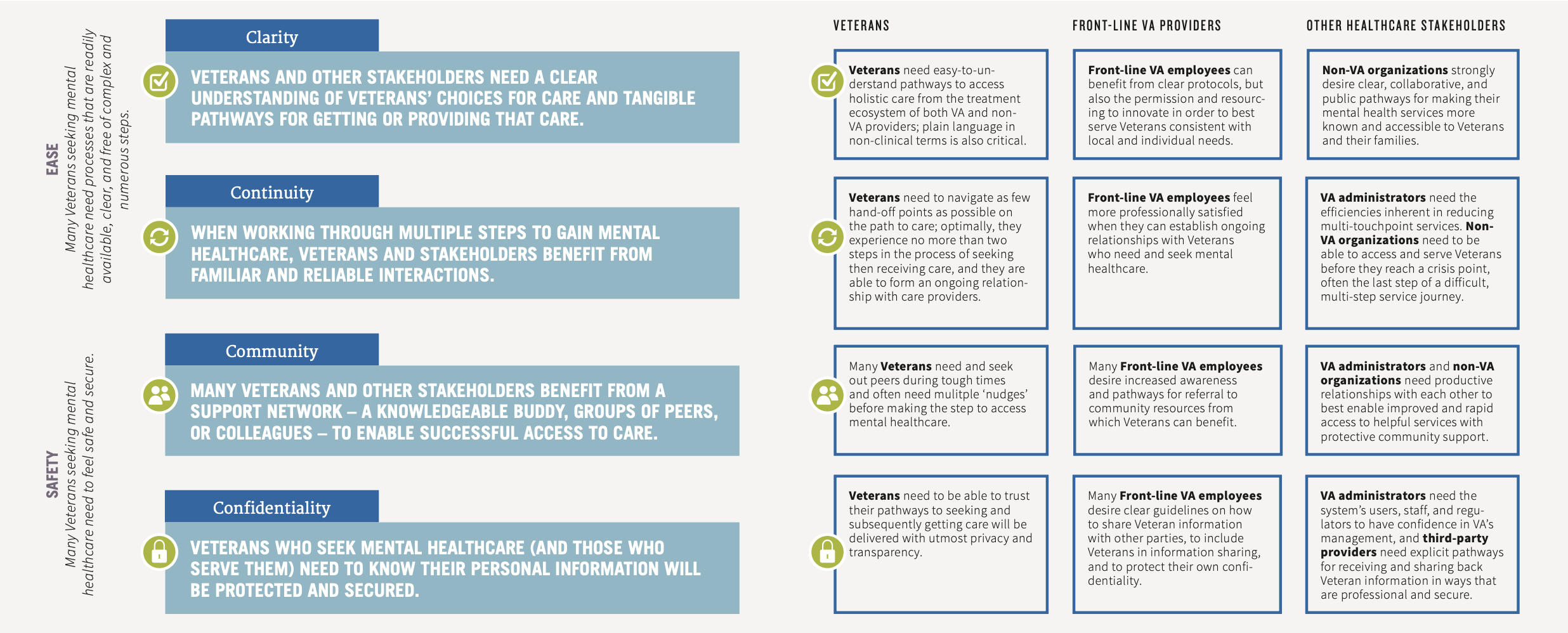
Diagram of shared needs
Drawing on our findings, we developed recommendations for improving access to mental healthcare across three timeframes, ranging from immediate fixes to large-scale institutional change.
Quick Wins address urgent, solvable problems that can have fast impact — efforts that could launch within the year.
Pilot Projects are design concepts for hands-on testing at VA medical centers and benefits offices — not finished solutions, but structured opportunities for collaborative prototyping with veterans, VA employees, and community partners.
System Transformations are the largest-scale opportunities — changes that go beyond what any single pilot can accomplish and require the engagement of VA leadership, legislators, and external partners.
We provided a service map of current mental health access experiences and design opportunities; a set of eight mental health personas — Fast Tracker, In Transition, Forging Ahead, Day-by-Day, Still Serving, Knowledgeable Buddy, Front-Line Provider, and Family Member — to drive veteran-centered decision-making; and visualized journey maps of veterans and their supporters gathered during fieldwork.
The findings and recommendations from this project were published in March 2016 as a formal report by the VA Center for Innovation and the Public Policy Lab. The report was designed not only as a research document but as a practical resource for VA leaders, policymakers, and frontline staff, offering actionable pathways to improve how veterans access mental healthcare.
The work built directly on PPL’s earlier human-centered design pilot with VACI and deepened the case for embedding user-centered approaches across the VA. By centering the voices of veterans and their supporters — including those often left out of system design, such as family members and trusted friends and mentors — the project illuminated both the barriers veterans face and the bright spots already working within the system that can be built upon and scaled.
PPL is a tax-exempt 501(c)(3)
nonprofit organization.
info@publicpolicylab.org
+1 646 535 6535
20 Jay Street, Suite 203
Brooklyn, NY 11201
We'd love to hear more. Send us a note and we'll be in touch.
Enter your email below to subscribe to our occasional newsletter.
Wondering what you’ve missed?
Check out our
The Public Policy Lab is a tax-exempt
501(c)(3) nonprofit organization.
Donate now to support our work; your
gift is tax-deductible as allowed by law.