By John Buckley
John Buckley is the practice director of Public Policy Lab Midwest.
As a nonprofit that partners with governments to improve the lived experiences of our shared clients—the American public—we often find ourselves pushing against rigid government systems. That can be an uncomfortable role.
Government agencies typically hire vendors to do a very specific thing: analyze a dataset, run a survey, produce a report. Their procurement systems are designed for clear scopes with familiar methods that lead to predictable outputs.
But much of our work sits in a different space. We are often contracted to identify novel ways of addressing systemic or operational challenges. We conduct discovery research to help understand complex systems in order to design interventions—such as new workflows, products, or programs—that are not always obvious before the project begins.
For program officers and procurement specialists, this can be a complete paradigm shift. Fixed government processes have numerous benefits, not least risk reduction and processing efficiencies. Reimagining systems in collaboration with other agencies, departments, stakeholders, contracted providers, staff, and service users exposes institutions to risk—which can result in uncertainty and stress for government partners.
There has been a seismic growth in awareness and acceptance of applying design methodologies to solve systemic public service challenges over the fifteen years of PPL’s existence. The idea of involving communities and frontline staff in the redesign of public systems has become commonplace. Where my colleagues and I would once speak about “why” it is important to do this work, we now communicate “how” to do it.
But even with this growing acceptance, we continue to influence those in positions of power: sometimes advocating for including other key system stakeholders in our partnerships; sometimes pushing for deeper engagement with service users and frontline staff; sometimes introducing research methods that center participants’ stories alongside administrative data analysis; and sometimes advocating for interventions that shift power toward the people most affected by policy decisions.
Additionally, as a public-service nonprofit, our mission is to improve public services for as many people as possible. Therefore, unlike private companies, we seek to ensure learnings and outputs from our projects with individual cities and states are made available to any other jurisdictions that could benefit from the work. Those of you with experience in government procurement can imagine the challenges this novel goal poses during the contracting process!
All of these changes to the status quo require the agreement and support of partners who can bend those rigid government systems. Therefore, before we pick up the pen to design interventions, we need to bring our partners along to ensure the right conditions are in place.
One project, early in my time here at PPL, helped us understand just how important it is to be thoughtful when introducing new mindsets and ways of working to our partners.
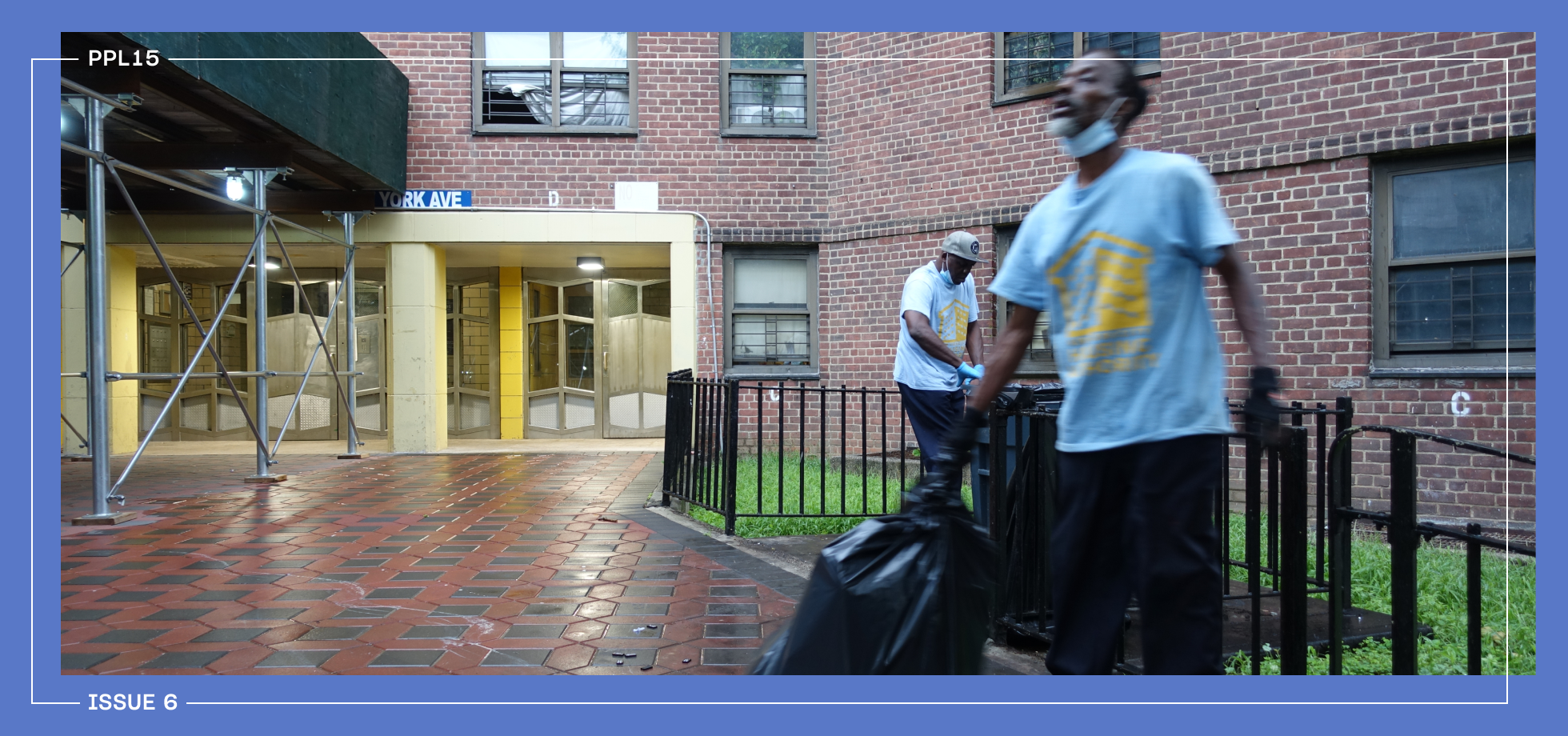
In 2020, the New York City Housing Authority (NYCHA) engaged PPL to evaluate a change to the work schedules of its caretaker workforce. Caretakers clean and maintain NYCHA’s buildings and grounds across hundreds of properties. For many years, most worked a traditional daytime schedule. NYCHA had recently introduced staggered shifts so caretakers could be present in the early morning and late evening—something residents had long requested. After this new “alternative work schedule” had been in place for some time, the agency wanted to better understand how it was functioning.
When NYCHA solicited proposals for this evaluation, they requested three components: statistical analysis of administrative data, a time-and-motion study of caretaker tasks, and qualitative interviews with staff and residents.
It was a thoughtful scope. But as we got to better understand their ambitions for the work, we saw opportunities to add nuance. For example, time-and-motion studies are often most effective in environments where tasks are standardized, such as in manufacturing plants or distribution centers. Caretaker work is very different. The size of a property, the number of residents, the condition of the grounds, and even the weather can shape how a given task unfolds. So, we suggested a few adjustments.
First, instead of conducting interviews and observing tasks separately, we proposed ride-along interviews where we could speak with caretakers while accompanying them during their shifts. This would help us understand the context behind the tasks we were observing and allow conversations to arise more organically, which was important because morale and accountability were believed to be key challenges.
Second, on learning that a key goal of our evaluation and recommendations was to align NYCHA leadership on a shared understanding and direction, we suggested documenting portions of the fieldwork through photos, audio, and video. We believed storytelling through rich multimedia could ensure that the realities of caretaker work didn’t get lost in spreadsheets or transcripts.
Our proposal to not center the time-and-motion studies and to record video and audio clips of the caretakers’ work was met with mixed feelings within NYCHA. Given that we were first-time collaborators, we had not yet earned the full trust of our government partners. Additionally, these changes required further approvals of our consent forms and other administrative tasks for our partners. Large public entities face significant privacy concerns when collecting recordings of staff and residents, and NYCHA could not take our proposed approach lightly. But after persistence on our part to demonstrate the benefits of this approach, and a genuine openness to try new things on the part of our NYCHA partners, we were able to combine several complementary lenses. We:
Ultimately, this broader research approach was effective. NYCHA leaders, upon seeing the multimedia research outputs backed up by quantitative analysis, appreciated the limitations of the time-and-motion study, understood the behavioral and relational effects of the new work schedule, and were ultimately convinced to act on our key recommendations. Given the hard push we made for leaning into the qualitative arguments, my colleagues and I let out a sigh of relief that we had made the right call in those planning stages.
The project ultimately taught me a great deal about what it takes to bring partners through change. Our process disrupted their expectations and anticipated ways of working, and they had been navigating uncertainty throughout the project. Looking across other projects, we began to realize that this experience was not unique to our partners at NYCHA.
During a team debrief after the project, we realized that while the design process is familiar and safe for us, our approach had made our partners uneasy, especially given the high stakes of the work. They eventually came around to our methods, but only after going through a journey of different emotions.
Looking across our projects, we saw that new partners often move through a recognizable, predictable emotional arc: Excitement at kickoff turns to overwhelm as we engage their staff and service users. Then, a wave of relief hits when we identify suitable interventions. We realized how important it was to help our partners move through that uncertainty while continuing to focus on our core design brief.
Since then, we’ve built several practices to address the points in the process that may feel uncomfortable for our partners:
It is incumbent on those who seek to drive change to recognize that the approaches we are championing are often at odds with normal government ways of doing things. The humans who do the important daily work of government bring different expectations, constraints, and ways of understanding change. This means that earning trust, generating buy-in, translating jargon, and helping them navigate uncertainty are central parts of our work.
It is not easy for an external nonprofit partner to push large public institutions to try something new. Government systems are built around established processes and familiar tools, often for good reasons. But some of our greatest value-add has been when we can bring a fresh perspective to an open-minded partner. It is in those situations, where we can influence both institutional culture and service delivery, that our organization makes its biggest impacts.
As the Public Policy Lab marks its 15th year, we’re publishing a series of essays reflecting on the projects that shaped us and what they’ve taught us about public-interest innovation. Each post is paired with a related conversation, bringing practitioners together to explore the theme and its implications for the future of public systems.
John Buckley, “The Humanity of Change-Making: Supporting Government Partners Through the Discomfort of Change,” New York, NY: Public Policy Lab, June 19, 2026, https://www.publicpolicylab.org/resources/humanity-of-change/
PPL is a tax-exempt 501(c)(3)
nonprofit organization.
info@publicpolicylab.org
+1 646 535 6535
20 Jay Street, Suite 203
Brooklyn, NY 11201
We'd love to hear more. Send us a note and we'll be in touch.
Enter your email below to subscribe to our occasional newsletter.
Wondering what you’ve missed?
Check out our
The Public Policy Lab is a tax-exempt
501(c)(3) nonprofit organization.
Donate now to support our work; your
gift is tax-deductible as allowed by law.