By Judy Park Lee
Judy Park Lee is the Public Policy Lab’s research director. She was also a PPL fellow from 2018-2019.
When I graduated from college, I longed—as many bright-eyed graduates do—to have an impact on the world. Not just any impact, but a measurably large one.
My first job, as a housing policy analyst, felt aligned with these ambitions of impact at scale. If I could change policy, I could affect the fate of entire sectors and nations. I could change the rules of the game. Energized by this idea, I dutifully spent hours researching the housing ecosystems of different countries and making policy recommendations to help stimulate more affordable housing production in those countries. These recommendations had the potential to impact millions of people—that is, if anyone read and fully digested the implications of my 80-page reports.
This was absolutely critical work. Yet, at times, it could be maddeningly abstract. Holed up in my cubicle, I felt disconnected from the people who were affected by the policies we proposed. What was their lived experience? How did these policies get translated into tangible services that met people’s real needs?
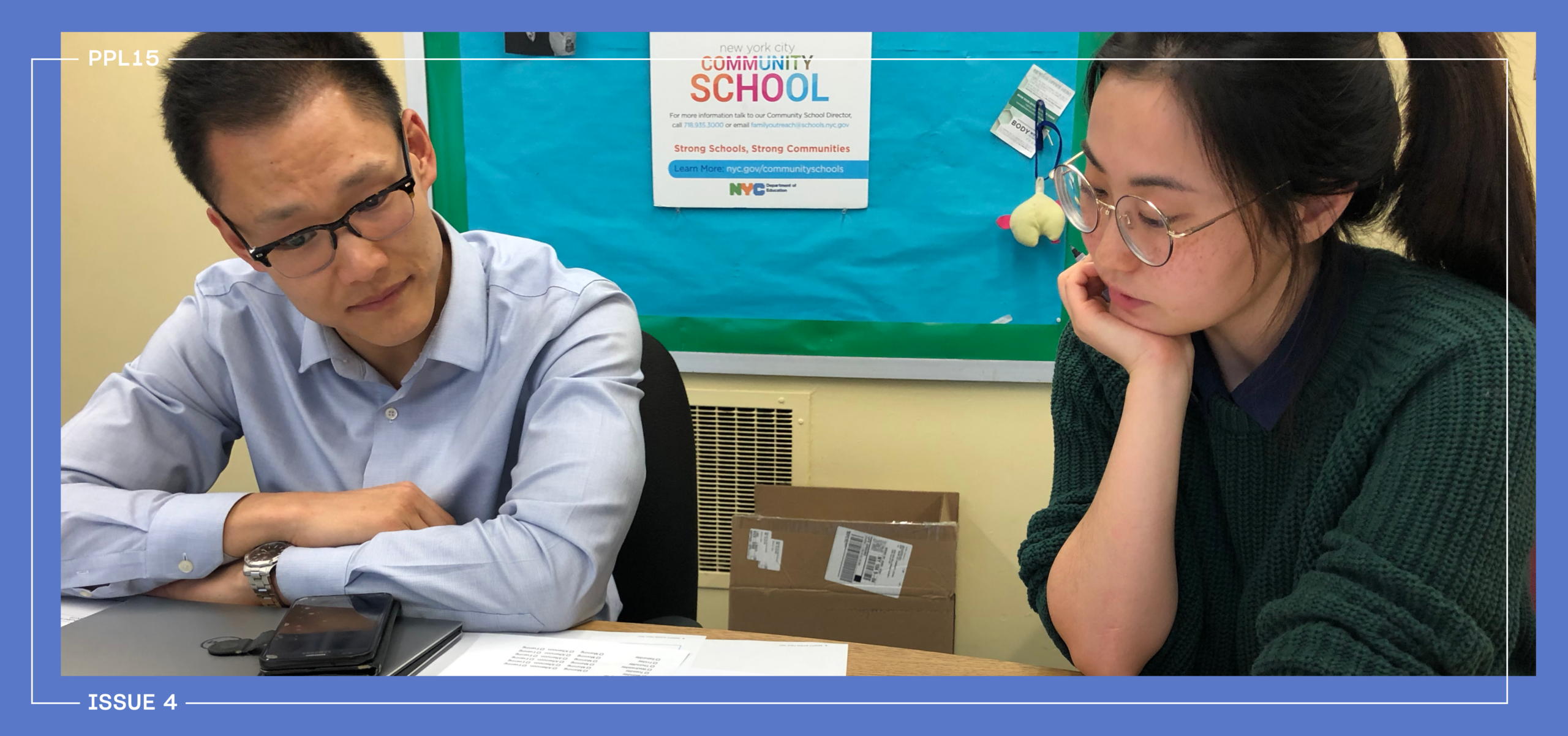
Those questions set me down a path that, years later, in 2019, led to my fellowship at the Public Policy Lab. When I started at PPL, I had a vague sense of what “service design” involved, but not much practical experience doing it. My first project was with the NYC Department of Education (DOE), which aimed to transform NYC’s community schools into neighborhood hubs where families could get connected to public benefits like SNAP and housing vouchers. Our brief was to develop a “benefits access” program model and set of tools that were scalable across all community schools in NYC (at that time, there were nearly 250 community schools, now there are over 400). For me, it was a crash course in service design, at the end of which I learned useful strategies for designing services at scale.
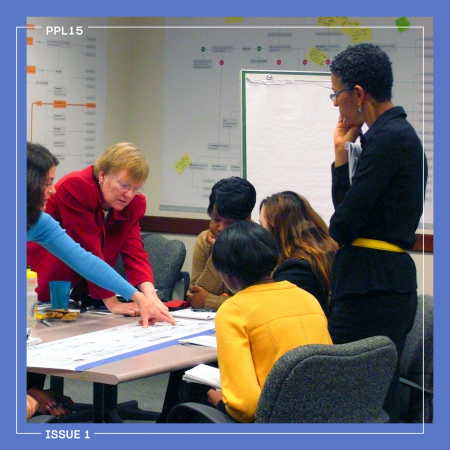
We started out by doing what we do in every PPL project: going and talking to people. After selecting a representative list of a couple dozen schools with our agency partners, we spent the next few months visiting all of them.
Getting to many of these schools required quite the trek; some days, we’d traverse multiple boroughs. But as taxing as it was, our visits revealed things that we wouldn’t have otherwise seen—such as the parent coordinator who, as we walked down the hallway together, had multiple parents stop to hug her and ask questions, or the coordinator who heaved a thick binder onto his desk, laughing, when we asked him how he kept track of resources for families. He added, “Most of it is relationships I have already, so I know exactly who to call. I don’t really refer to this anymore.”
Over the course of the project, we talked to over 200 people, including school directors, staff, and families. We could have talked to fewer people, or sent out surveys, or even conducted remote interviews. But we would have missed out on valuable contextual information—such as the persistent follow-up and cultivation of trust needed to work with families—that impacted our design decisions.
Crucially, the in-person visits also allowed us to build key relationships. Administrators who were difficult to chase down over email ended up being open and generous with their time when we showed up. They were quicker to respond when we reached out to them later on the project. It wasn’t mandatory for schools to participate in this project, or even to implement what we made at the end of it, so these relationships were all the more essential to getting buy-in. Not only that, but once people were engaged, they became internal champions for the work within their schools.
When our team first received the project brief, we imagined designing an innovative model that revolutionized how schools approached benefits access. But when we visited the schools, we saw that they were already doing the work, cobbling together what time and resources they had to help families. Parent coordinators were accompanying families to their benefits appointments, teachers were flagging needs they noticed among their students, and directors were holding benefits fairs with local organizations. Some schools had more dedicated resources and organized systems than others, but all of them were connecting families to benefits in one way or another.
What they needed was not so much a new model, but rather, ways to coordinate and support their existing work. To do that, we collected the best practices we saw among schools and used them to design adaptable templates. We also created planning and evaluation tools that helped staff align their disparate responsibilities. We then knit all of these together in a clear, simple strategy that echoed what was already being done on the ground. Our goal was to help school staff see benefits access as a collaborative and proactive effort, rather than siloed and reactive.
This wasn’t the radical transformation we expected to make. However, by layering onto existing workflows, roles, and tools—helping people do what they were already doing better—there was a stronger chance that our changes would be adopted by staff and result in immediate impact. This incremental approach isn’t always the right choice; when the existing system remains ineffective over time, or actively harms users, a sweeping overhaul may be needed. But, in other cases, the most effective way to change the system may be activating the infrastructure that’s already there, formalizing desire paths that have already been forged, and finding the right leverage points to trigger meaningful shifts in people’s mental models.
The challenge of this project was developing a model that could encompass the work of all NYC community schools, while remaining useful for any individual school’s unique needs. If we prioritized universality, the model would become too generic. If we focused too much on meeting specific needs, we’d end up with narrow or highly-specialized interventions that couldn’t scale.
Our approach to this tension—which we’ve used in multiple projects over the years—was to design an overarching program model and pair it with a flexible toolkit. The program model would prescribe the fundamental steps required to achieve the goal or outcome, while the toolkit would offer tools, methods, templates, and other resources to execute these steps. To further encourage adoption, we outlined different iterations of the model that schools could choose from, depending on their staff capacity and community needs.
Ultimately, the goal was to encourage a self-sustaining community of practice: individual organizations adapting the model, sharing successful strategies, uploading their own templates, helping each other troubleshoot issues, and coming up with solutions together. The ideal interaction would be something like what happens within the comments section of a New York Times (NYT) Cooking recipe. A writer publishes an original recipe born out of their research, and readers offer their own “notes” on that recipe, including everything from ingredient substitutions to alternative cooking methods to other interesting digressions. The risk is that people may deviate from the initial script—which NYT readers are notorious for—but opening this kind of space for experimentation can also lead to entirely new ideas and techniques.
Since working on the benefits access project, PPL has designed policies and services at even larger scales, including simplifying tenant applications for the nation’s largest subsidized housing programs and proposing federal policies to better support families in childbirth and early childhood. These subsequent projects have added new scaling strategies to our playbook and helped us crystallize a framework for systems change in government, which we call the Public Policy Layer Cake. In it, we posit that systems change requires building products that transform the work of government staff and their interactions with members of the public at multiple layers. As designers, engaging in that work calls for a certain kind of mental agility—the capacity to continuously zoom in and out, to think expansively while drilling down, and to translate many diverging goals into useful products.
Personally, in the last decade or so since starting my career, my thoughts about scale have grown more complicated. Does having an impact mean reaching the largest number of people? Or is it better to aim for a deeper, more transformative outcome in a local setting? And, in a time when the dedication to scale verges on axiomatic, is it really necessary or useful to scale everything?
While these questions remain open, what I know for sure is that there are no shortcuts—at least when it comes to changing the systems that deliver essential public services. This venture requires intensely relational work: observing and listening to people, building trust, negotiating common ground, maneuvering constraints, and facilitating collective action. This work takes time and it can’t be supplanted by non-human agents. And while change can happen in one fell swoop, such seismic events are often the result of many people working in small ways, together, over time, to set the conditions for their arrival.
As the Public Policy Lab marks its 15th year, we’re publishing a series of essays reflecting on the projects that shaped us and what they’ve taught us about public-interest innovation. Each post is paired with a related conversation, bringing practitioners together to explore the theme and its implications for the future of public systems.
Public Policy Lab, “PPL 15: No Shortcuts to Scale,” New York, NY: Public Policy Lab, April 30, 2026, https://www.publicpolicylab.org/resources/no-shortcuts-to-scale/
PPL is a tax-exempt 501(c)(3)
nonprofit organization.
info@publicpolicylab.org
+1 646 535 6535
20 Jay Street, Suite 203
Brooklyn, NY 11201
We'd love to hear more. Send us a note and we'll be in touch.
We are accepting applications for a Graduate Summer Intern until February 23, 2026.
To hear about future job announcements, follow us on Instagram, Twitter, Threads, and LinkedIn or subscribe to our newsletter.
Enter your email below to subscribe to our occasional newsletter.
Wondering what you’ve missed?
Check out our
The Public Policy Lab is a tax-exempt
501(c)(3) nonprofit organization.
Donate now to support our work; your
gift is tax-deductible as allowed by law.