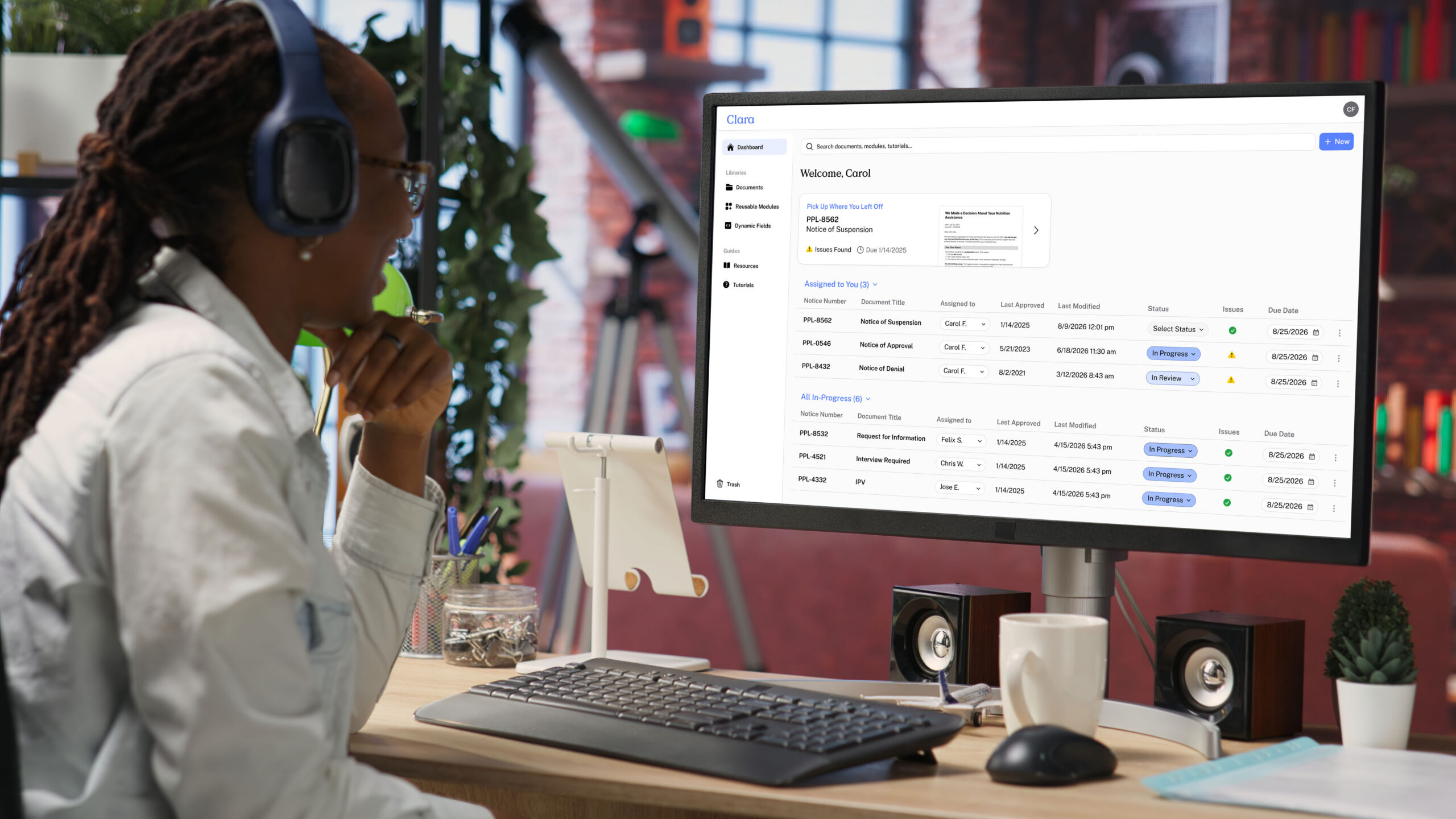
Public benefit programs use notices to communicate with beneficiaries about their benefit status and required actions. But these notices are often dense, technical, and hard to act on. We’re developing CLARA, an AI-assisted tool that helps states generate compliant notices that are understandable to the families who receive them.
CLARA, launching in fall 2027, will enable states to create and update compliant, plain-language SNAP notices quickly and easily — reducing confusion for beneficiaries, lowering administrative burden, and improving families’ access to benefits.
Public benefit programs use notices to communicate with beneficiaries about their benefit status and required actions. But these notices are often dense, technical, and hard to act on. We’re developing CLARA, an AI-assisted tool that helps states generate compliant notices that are understandable to the families who receive them.
CLARA, launching in fall 2027, will enable states to create and update compliant, plain-language SNAP notices quickly and easily — reducing confusion for beneficiaries, lowering administrative burden, and improving families’ access to benefits.
SNAP programs are essential to helping families across the U.S. put food on the table, but many states face the risk of funding cuts. New federal rules require states with SNAP payment error rates above 6% to repay a portion of federal benefit costs — for the first time in the program’s history. SNAP error rates measure how often a state makes mistakes when deciding who qualifies for benefits and how much assistance they should receive. These mistakes include giving people too little or too much assistance.
A significant share of those errors is driven by unclear, overly technical, or contradictory notices that confuse beneficiaries and create avoidable administrative burden. When families can’t make sense of a notice, they miss deadlines, submit incorrect information, or lose benefits they’re legally entitled to.
We are developing CLARA, Clear Language AI Review Assistant, to streamline notice generation. Our tool will enable staff to create and update notices more quickly and easily. By improving clarity, actionability, and accessibility, CLARA aims to reduce confusion, lower administrative errors, and create a smoother experience for families.
PPL conducted research with state staff across roles — including SNAP directors, policy analysts, technology teams, quality control specialists, and caseworkers — as well as with beneficiaries and subject matter experts in the federal compliance landscape.
In analyzing the experience of policy analysts, PPL found that fear of non-compliance shapes nearly every decision in the notice-writing process. Analysts genuinely want to write clearly. But they are caught between that goal and the risk of straying too far from regulatory language which could lead to failing federal compliance evaluations. That tension produces slow, informal workarounds: version-controlled documents passed around by email, months of back-and-forth with leadership and legal counsel, and deep reliance on institutional memory held by single workers.
Are our notices easy to read? No. We've tried to change the language, but we can't stray too far from USDA’s verbiage because that would be a finding in the audit.”
—Paraphrased from Policy Analyst
Many policy analysts described wanting a thought partner — someone to double-check their readability and help with policy interpretation — in a role that rarely has one. One participant reflected:
“Sometimes I feel like I’m working very much alone. I wish I had someone else who knew it all off the bat. Someone I can ask ‘Am I doing this right? Is this the best way I can do it?'”
In analyzing the experience of beneficiaries, PPL found that the consequences of unclear notices are concrete and serious. Dense text blocks, technical jargon, and action items buried in long paragraphs all contribute to notices that people can’t make sense of or take action on. When beneficiaries can’t act on a notice, they may lose benefits they are entitled to — and often don’t know they had the right to appeal.
Frontline staff underscored the consequences of beneficiary confusion. Most reported that they spend 5 to 10 hours a week fielding phone calls, emails, and in-person visits from beneficiaries seeking clarity about a notice. Commuting to the SNAP office or waiting on hold for staff support costs beneficiaries time and money, against the backdrop of an already-precarious financial situation. One caseworker remarked:
“A lot of our clients don’t have the means to get [to the SNAP office] to begin with. So they’re trying to get a ride, they’re walking from across town, they’re trying to catch a bus, doing anything they can to get up here because the notice didn’t make sense to them. That’s the biggest thing. It’s not just the calls. It’s people that are having to miss work or use the very little money they have to try to come up here to get an explanation on this notice.”
My husband can read, but to understand the notice, he needs to read it multiple times or ask somebody to read it to him."
—Paraphrased from a beneficiary
PPL is building on these findings to design CLARA, an AI-powered web application that guides policy analysts through producing SNAP notices that meet federal requirements and communicate clearly. The tool draws from a regulatory knowledge base built from multiple SNAP policy sources, as well as a plain-language knowledge base that reflects international plain-language best practices and SNAP-specific language guidance gleaned from PPL’s previous notice redesign work.
We tested early versions of CLARA with policy analysts and subject matter experts, iterating on the interaction design based on what users found trustworthy and useful in a real approval workflow. In our design approach, human engagement has been key. We’re designing CLARA to keep policy analysts actively engaged at every step. Humans will shape decisions before they happen rather than reacting to the AI output after the fact.
Next, we’re moving into co-design where we’ll work with policy analysts, frontline staff, and subject matter experts to refine tool features, complete wireframes, and guide the full development of the web application. We’ll also convene a multi-state advisory cohort for additional feedback and testing.
Following co-design, we will pilot the tool with our partner state, North Carolina. This phase will validate the tool’s design in a real-world context and test whether it reduces the time and effort required to produce compliant, clear notices. We’ll do testing with beneficiaries to ensure that the output is clear and actionable, and with analysts to ensure they can confidently stand behind the output. Implementation and scaling are planned for completion by fall 2027.
As the tool matures, PPL intends to expand it to additional state partners and to apply its methods to benefit programs beyond SNAP. We’ll build on the regulatory knowledge base and plain-language infrastructure developed in this phase to support clearer government communication more broadly and across languages.
Interested in partnering with us? Reach out at info@withclara.org.
PPL is a tax-exempt 501(c)(3)
nonprofit organization.
info@publicpolicylab.org
+1 646 535 6535
20 Jay Street, Suite 203
Brooklyn, NY 11201
We'd love to hear more. Send us a note and we'll be in touch.
Enter your email below to subscribe to our occasional newsletter.
Wondering what you’ve missed?
Check out our
The Public Policy Lab is a tax-exempt
501(c)(3) nonprofit organization.
Donate now to support our work; your
gift is tax-deductible as allowed by law.