By Stephanie Yim
Stephanie Yim is product director and senior advisor at the Public Policy Lab.
The work of systems and transformation in government is a slow, incremental, and fractured process. Many theories about the key ingredients that make transformations possible have emerged to address this difficulty. McKinsey & Company has their 5 C’s: committed leadership, capacity, clear purpose and priorities, cadence in coordination and delivery, and compelling communication. Others name the need for citizen-led design, (preaching to the choir here), patience (sensible), and ownership of decisions and risks (harder said than done). It’s clear that all of these elements and more are necessary when it comes to facilitating transformation in existing systems, a demanding process that requires consistent, active effort. Then, the key question becomes: how can we as service designers cultivate and encourage transformation in our projects and work with partners?
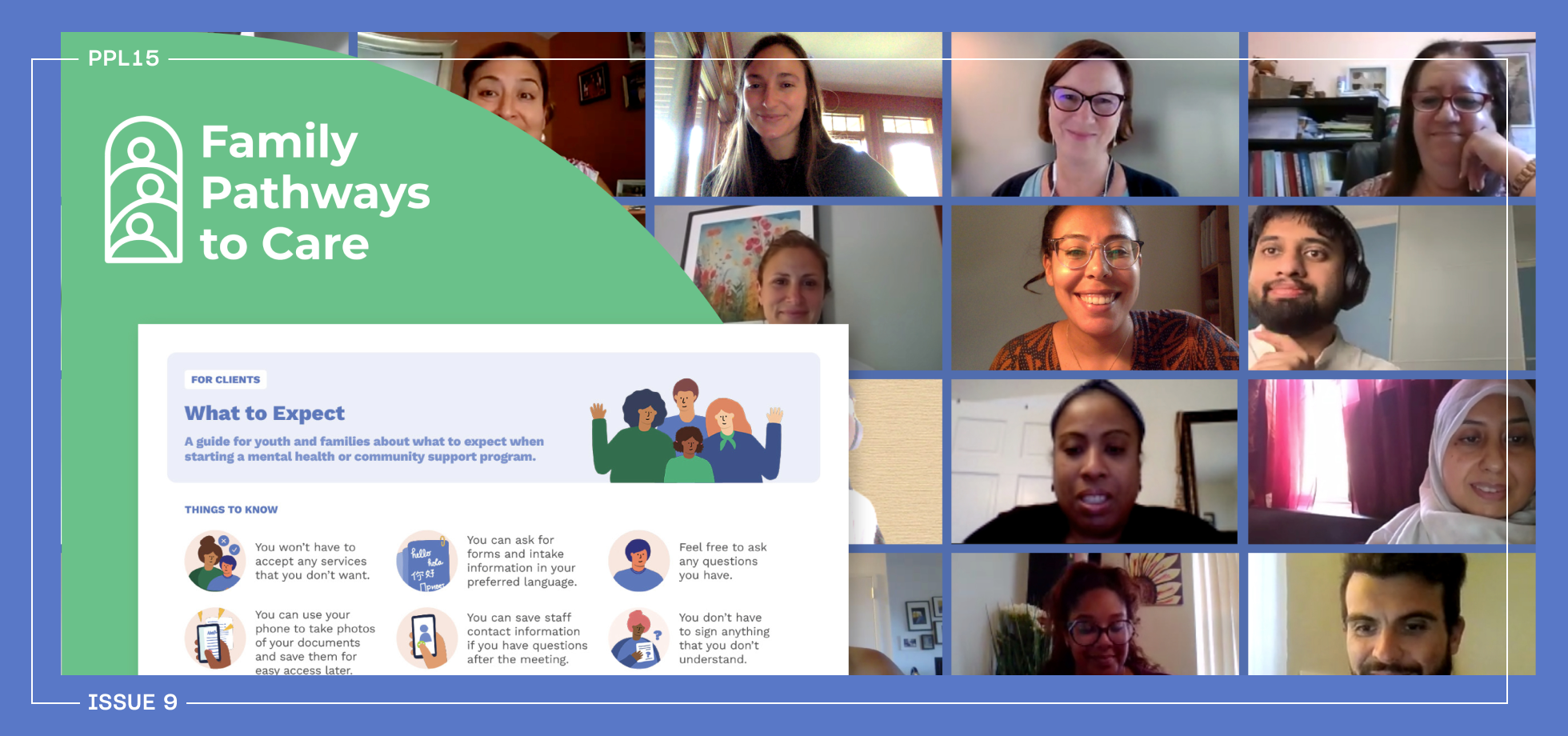
When I think about transformation, I think about Family Pathways to Care, one of the first projects I led at the Public Policy Lab in 2020. The project was a cross-agency collaboration between teams at the New York City Department of Mental Health and Hygiene (DOHMH) and the Administration for Children Services (ACS) to improve and more seamlessly connect families and youth to mental health and therapeutic services.
The project transformed the way mental healthcare is coordinated across City agencies. Rather than services being delivered in siloes, we created a pathway model for ongoing cross-agency collaboration that continues to be an inspiration for many other projects. Family Pathways to Care created a new mental model for how families should experience mental health and therapeutic services at the point of intake, referral, and feedback. The project successfully culminated in a joint letter signed by both agency commissioners championing and mandating the changes across the city’s mental health providers.
The project started with potential for transformation: a bold vision, committed leadership, and an interest in using human-centered design. However, potential is not enough for transformation in the context of public service delivery, where there are diverse stakeholders, fragmented funding, limited resources, and regular administration changes. Three approaches ultimately contributed to the project’s success: having champions on the ground, providing regular support throughout implementation, and allowing ample time for transformation to take root. As service designers, we’ve since used the strategies developed during this project to help our government partners through organizational change in future projects. But what we’ve learned above all is that transformation is a dynamic, iterative process.
After four months of closely collaborating with and incorporating feedback from provider frontline staff and families on new intake, referral, and feedback tools — a process we call codesign — we were finally ready to pilot the tools we had designed.
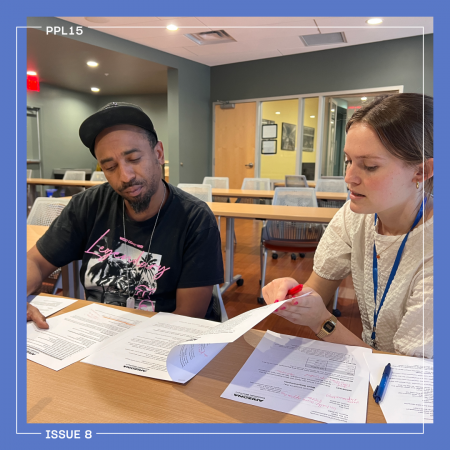
Up until this moment, we had been only working with our ACS and DOHMH partners and had not met any of the provider staff who were being asked to pilot these new tools amidst their busy case loads (we had codesigned the tools with a different set of providers and staff). Asking frontline staff to change their processes overnight was a tall order. Instead of immediately asking staff to pilot, we decided to spend two extra months onboarding, training, and building their trust in the products and in us. Using a train-the-trainer model, we met the staff weekly to teach them the tools, but more importantly, to prepare them to adopt a new paradigm for how and when they made referrals. True transformation requires consistent trust-building with our collaborators in the field. Beyond committed leadership, transformation needs frontline staff who can be champions of the change.
Thanks to the extra time we invested into training and preparing them for the pilot, these staff members eventually became our pilot leaders, scaling the project across their agency and others. With this extra preparation, the pilot leaders clearly understood the transformation goals and priorities and felt ownership over the change they needed to drive. One of our providers even created an internal competition to see which of their teams collected the most feedback from their families using our tools. This experience prompted us to add an entirely new phase to our service design process, which we call “Stage.” This phase is focused on creating the necessary systems for our partners to launch the products we’ve designed.
Prior to Family Pathways to Care, most PPL projects ended with the delivery of newly-designed products and services (a.k.a. prototypes) to our partners. We noticed, however, that these prototypes were sometimes not implemented or adopted despite early interest and commitment. Before products can launch publicly, we had to secure approvals from different stakeholders like leadership (who were very busy), legal (who had a lot to say), or marketing (who wanted to tell you what to say). This can result in delays that could halt a transformation.
During this project, we learned that it was helpful to meet our partners every other week to identify, facilitate, and track the necessary approvals for implementation. We worked with the legal team to approve the new public-facing materials and with the comms team around what an agency-wide announcement looked like. To be transformative, our projects cannot end after the redesigning of pilot materials. After all, designing a transformative product is one thing, but implementing and integrating it into existing systems is completely another. We noticed the importance of a regularly updated set of communication assets and a clear project narrative to help our partners get approvals and the buy-in from other stakeholders.
This resulted in the addition of a new communications approval process to our future projects. Our learnings culminated in the expansion of two additional phases to PPL’s project release model: “Integrate” and “Scale & Share.” In “Integrate,” we work with partners to obtain the necessary sign-offs required for implementation, and in “Scale & Share,” we support our partners in systemwide rollouts of products and in communicating the key takeaways of the project to the outside world. These phases are not afterthoughts, but crucial components to transformation. We learned through Family Pathways to Care that implementation and storytelling of the project merit its own discrete phase of the design process.
Transformation takes time. Transformation in government systems takes even more time. Many projects end before we get to see our project outcomes implemented, and some never do. Resources run out, the project staff changes, or priorities shift. Buy-in and value takes time to build—time most government partners cannot afford to spend.
Because of the excitement and success of the Family Pathways to Care pilot, we had the unique opportunity of receiving funding for another year for PPL to support implementation. During the extra year, the commissioners of both agencies finalized a joint announcement of the new tools, our partners trained all the city’s provider agencies, and we were able to troubleshoot any implementation challenges together. This extra time proved crucial to the project’s long-term success.
Family Pathways to Care is our longest completed project, spanning three years of methodical transformation work. While not all of our projects are necessarily this lengthy, our experience with this project shaped PPL’s strategy for how long we scope projects for transformation. Transformation is possible if we understand the time it takes for meaningful change to happen. If we want to do transformative work, we discovered, we need to factor in time for all phases of work, from scoping all the way through implementation. Even when we cannot have extra time, it is still valuable to approach transformation with a mindset that progress can be made incrementally over a longer horizon. It is important to plan for that longer horizon alongside shorter-term interventions, because transformation can happen in phases. As service designers, we can support our partners in finding funding or developing proof-of-concepts and buy-in to keep the momentum to ignite the next stage of the work.
Family Pathways to Care was an incubator for many frameworks and methods that we use today at PPL. The project began in 2020 during the wake of a global pandemic, a moment that redefined many paradigms of how we thought about public service delivery. In learning about what is necessary to transform government systems, PPL developed new approaches that also transformed how we worked. The project turned out to be a crucial testing ground for our current design process, which utilizes ten different phases to shepherd a project through development. As described above, our experience with Family Pathways to Care specifically added three new phases to our process, which dedicated more time to supporting our partners on the ground during implementation and sharing our results with the wider world.
Sometimes it’s hard to see when a transformation happens when you’re in the midst of it, but you feel it after the fact. Upon reflection, you realize there was a before and an after, and the after has forever changed how you behave, what you think, and even what you believed is possible. The latter is why the pursuit of transformation is important even if you do not know how to get there initially. What Family Pathways to Care taught us is that transformation is not an end state, but an active mindset with an iterative process. As service designers, our capacity to imagine, facilitate, and build transformations is important to get us to the future states we want.
We continue to iterate on our own processes for transformation, implementing new methodologies like the dual timeframe framework to build long-term change. In the case of Family Pathways to Care, our ability to facilitate transformation, and our partners’ willingness to remain open to the process, resulted in a holistic approach on mental health care that not only improved referral pathways across agency services, but also sought to build trust and greater family voice in the service experience. Therapists that worked in the same provider organization on different programs served the same families but previously never spoke with each other. Now, they work side by side to support the family together. The referral model has continued to inspire our other projects like Prevention Pathways and Economic Security. It’s difficult to fathom that all of this began in 2020 with one simple project goal. The first step of transformation, it turns out, is believing you can.
As the Public Policy Lab marks its 15th year, we’re publishing a series of essays reflecting on the projects that shaped us and what they’ve taught us about public-interest innovation. Each post is paired with a related conversation, bringing practitioners together to explore the theme and its implications for the future of public systems.
Stephanie Yim, “The Practice of Transformation: A Dynamic Approach to Changing Government Systems,” New York, NY: Public Policy Lab, October 23, 2026, https://www.publicpolicylab.org/resources/ppl-15-the-practice-of-transformation/
PPL is a tax-exempt 501(c)(3)
nonprofit organization.
info@publicpolicylab.org
+1 646 535 6535
20 Jay Street, Suite 203
Brooklyn, NY 11201
We'd love to hear more. Send us a note and we'll be in touch.
Enter your email below to subscribe to our occasional newsletter.
Wondering what you’ve missed?
Check out our
The Public Policy Lab is a tax-exempt
501(c)(3) nonprofit organization.
Donate now to support our work; your
gift is tax-deductible as allowed by law.